Series 1976 $2 Bill: History, Value, and Collectability
In the mid-1970s, the United States celebrated 200 years of independence from Great Britain. As a result, the nation released a wide range of patriotic and numismatic items. Among them, one issue stands out: the Series 1976 $2 Federal Reserve Note.
 Collectors recognize this note as the first $2 Federal Reserve Note (FRN). Moreover, it introduced the reverse design that remains in use today. Best of all, most examples remain accessible and affordable.
The Bicentennial and U.S. Currency Redesign
The Bicentennial inspired numerous numismatic releases.
First, the United States Mint began striking Bicentennial medals in 1972. Then, in 1973, President Richard M. Nixon signed legislation authorizing commemorative reverse designs for the quarter, half dollar, and dollar coin. The law also mandated the dual date “1776–1976” for coins struck in 1975 and 1976.
Today, collectors can still find Bicentennial coinage in circulation, although locating high-grade examples has become more difficult.
At the same time, officials approved a redesign of the $2 note. In late 1975, the Treasury authorized production of a new $2 Federal Reserve Note to coincide with the Bicentennial celebration.
Treasury Approval and Official Announcement
On November 3, 1975, Treasury Secretary William E. Simon announced that the Bureau of Engraving and Printing (BEP) would produce $2 Federal Reserve Notes for the first time.
Although the Bicentennial inspired the new design, the government did not classify the Series 1976 $2 note as a commemorative issue. The New York Times clarified this point on November 9, 1975:
“[T]he bill is not a ‘special’ Bicentennial‐year issue; it will continue on as a permanent part of the nation’s circulating paper currency.”
Therefore, the note entered circulation as a regular-issue Federal Reserve Note.
How the Series 1976 $2 Bill Differs from Earlier Issues
The Series 1976 note marked an important transition.

Previously, the government issued $2 notes in the 1960s as Legal Tender Notes. Those notes carried red Treasury seals and red serial numbers. Since the 1860s, the denomination had also appeared as National Bank Notes, Silver Certificates, Treasury Notes, and Federal Reserve Bank Notes.
However, the Series 1976 issue became the first $2 Federal Reserve Note. As expected, it featured a green Treasury seal and green serial numbers.
The obverse retained the familiar portrait of President Thomas Jefferson. In contrast, the reverse underwent a complete redesign.
The Declaration of Independence Reverse
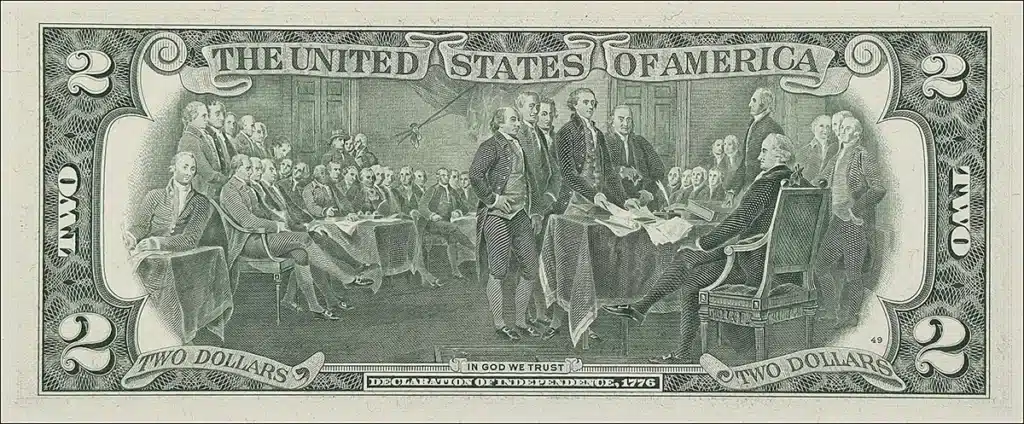
The BEP replaced Jefferson’s Monticello with a vignette based on John Trumbull’s 1817 painting, Declaration of Independence. BEP engraver Peter Cocci adapted the artwork for the note.
Importantly, this marked the first appearance of the Trumbull design on the $2 denomination. However, it did not represent the painting’s debut on U.S. paper money. The image had previously appeared on the back of $100 National Bank Notes in 1863.
The reverse displays the denomination as numerals in each corner. Scrollwork frames the written denomination at the bottom. Additionally, the words “TWO DOLLARS” appear vertically on both sides of the central vignette.
Trumbull’s painting also appeared on Bicentennial commemorative postage stamps, issued in four sections.
Production Figures and Signatures
The Bureau of Engraving and Printing produced 590,720,000 Series 1976 $2 bills between 1976 and 1978.
Each note bears the signatures of:
- Treasury Secretary William E. Simon
- Treasurer of the United States Francine Irving Neff
Officials released the notes on April 13, 1976, Thomas Jefferson’s birthday.
Star Notes – Scarcity – Error Notes

Most Series 1976 $2 notes remain common. Nevertheless, certain varieties command attention.
The scarcest Star note in the series carries the Friedberg catalog number F-1935-J* (Fr. 1935-J*). Minneapolis Star notes also rank among the more elusive issues.

Collectors seek Star notes because the BEP used them as replacements for misprinted notes. Consequently, they appear in smaller quantities.
Public Reception and Circulation
Before release, some observers predicted strong commercial acceptance. An April 11, 1976, New York Times article projected that the $2 note could replace half of the $1 bills in circulation. Officials estimated annual printing savings between $4 million and $7 million.
However, widespread circulation never materialized. In fact, many Americans treated the denomination as unusual or even suspicious. Over the years, some retailers have questioned the legitimacy of $2 notes. In rare instances, authorities even arrested individuals attempting to spend them.
As a result, the denomination remains uncommon in daily commerce.
Stamped First-Day Issues: A Bicentennial Collectible
Release day created a unique collecting opportunity.
On April 13, 1976, many Americans brought newly issued $2 bills to local post offices. They affixed Bicentennial commemorative stamps directly to the notes. Then, postal clerks canceled the stamps with official postmarks.
This crossover collectible appeals to both notaphilists and philatelists. Although most stamped notes trade near face value, collectors sometimes pursue examples from specific hometowns or meaningful locations.
Art Friedberg, co-author of Paper Money of the United States (22nd edition, 2021), recalled strong demand at the time:
“It was different, it was collectible, people loved it. We made a lot of money.”
Robert Azpiazu, owner of First City Coins and Collectibles and author of Collector’s Guide to Modern Federal Reserve Notes: Series 1963–2009 (2011), noted:
“There are some cancellations that are very valuable but only to a small group of eclectic collectors.”
Appearances in U.S. Mint Products
The Series 1976 $2 note also appears in official U.S. Mint products. Notably, the 1994 Thomas Jefferson 250th Anniversary Coinage and Currency Set includes a Series 1976 $2 bill paired with a Satin Finish Jefferson Nickel.
Grading Population and Market Values
As of July 10, 2024, Paper Money Guaranty (PMG) reports 18,830 total grading events for Series 1976 $2 notes across all 12 Federal Reserve districts. Of those, 6,040 represent Star notes.
In today’s market:
- Circulated examples typically trade at or near face value.
- Uncirculated notes often sell for $3 to $4.
- Star notes command higher premiums.
- High-grade examples and collectible serial numbers bring stronger prices.

For example, Friedberg 1935-L with serial number 1 realized $21,150 at a Heritage auction on January 8, 2016. The note retained its original BEP brick label.
Why Collectors Still Pursue the Series 1976 $2 Bill
The Series 1976 $2 Federal Reserve Note holds lasting appeal.
- First, it represents the first $2 FRN in U.S. history.
- Second, it introduced the Declaration of Independence reverse that remains in use today.
Finally, collectors can acquire most examples for little more than face value.
Therefore, the Bicentennial $2 bill offers history, artistry, and affordability in one iconic American note.
The post The Bicentennial $2 Bill – First of a Kind appeared first on CoinWeek: Rare Coin, Currency, and Bullion News for Collectors.
from CoinWeek: Rare Coin, Currency, and Bullion News for Collectors https://ift.tt/hBEtslp


