The 1974 Aluminum Cent Almost Reached Auction. Then the U.S. Mint Took It Back.
The 1974 aluminum cent ranks among the most famous “coins that never were” in American numismatics. It did not fail because the Mint lacked ambition. It failed because economics, politics, technology, and public safety all collided at once. That collision gave the hobby one of its great modern mysteries: a lightweight experimental cent that the Mint struck in huge numbers, recalled almost at once, and still treats as government property.
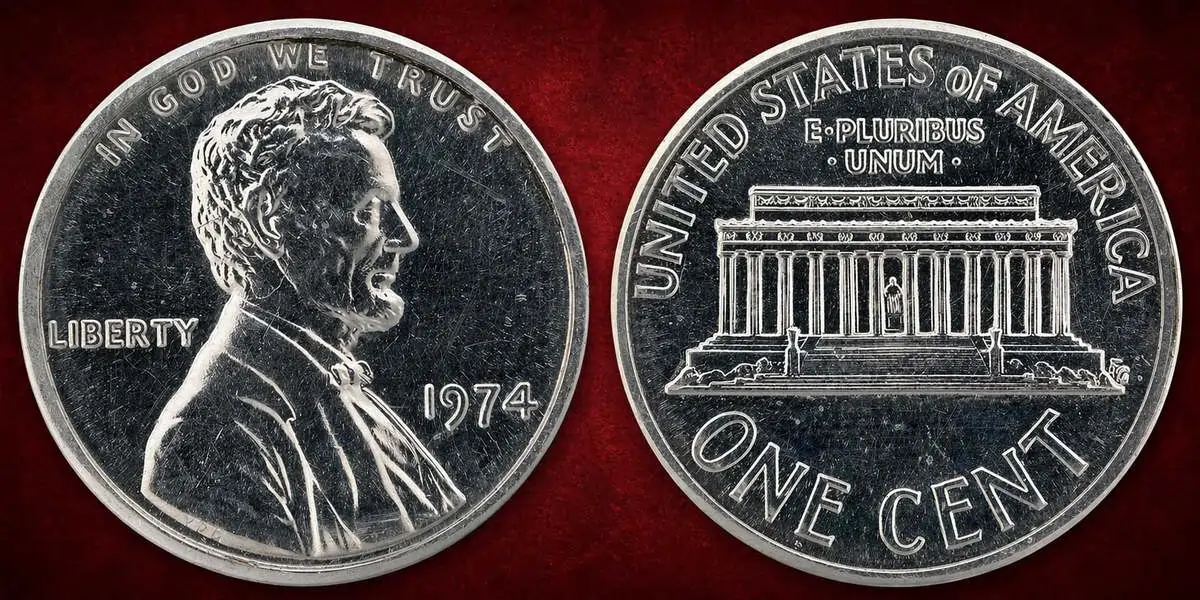
First, the Mint had a real problem. In 1973, copper prices rose so sharply that the metallic value of the cent nearly matched its face value. At the same time, commerce demanded enormous numbers of cents. The Mint therefore studied cheaper alternatives, including plated steel and aluminum. After that review, it chose a 96% aluminum alloy as the best candidate. The Philadelphia Mint then struck more than 1.4 million experimental pieces dated 1974 in anticipation of a possible change.
That choice made sense on paper. Aluminum looked clean. It resisted tarnish. It also treated dies kindly. In other words, the metal solved the cost problem and promised efficient mass production. Yet a good lab result does not always survive the real world. Here, the real world pushed back hard.
Why the Mint Tried Aluminum in the First Place
The Mint did not chase a gimmick. It chased survival. Between 1959 and 1973, cent production rose almost sixfold, and the supply problem worsened as copper prices spiked and speculation pulled cents into hoards. Treasury responded by backing legislation that would have allowed a permanent shift from the old bronze alloy to a cent containing at least 96% aluminum. House hearings followed in March 1974.
However, the opposition arrived fast. Vending interests argued that the much lighter aluminum cent would jam machines when people inserted it into nickel or dime slots. Medical experts raised a second problem. Pediatricians and radiologists warned that X-rays could struggle to detect an aluminum coin if a child swallowed one. Congress heard both objections. Then Congress rejected the aluminum-cent proposal and moved toward a different framework that let Treasury adjust the cent’s copper-zinc composition if conditions demanded it.
Meanwhile, market conditions changed. The Mint later explained that copper prices fell by the end of 1974 after the government released stockpiled copper. That price drop eased the immediate emergency. Later, when copper pressure returned in 1982, the Mint finally changed the cent’s composition, but it chose copper-plated zinc, not aluminum. In hindsight, the 1974 aluminum cent did not lead to the future. It pointed to a future Congress refused to accept.
Congress Said No. The Recall Began. Then the Story Turned Strange.
Once Congress rejected the aluminum cent, the Mint recalled the experimental pieces and intended to melt them. That part sounds simple. The next part does not. During the legislative push, the Mint had distributed sample pieces to members and staff of the House and Senate banking committees and to other officials. Later records show that the government could not account precisely for how many samples had circulated in Washington and how many still remained outside Mint custody.
That gap matters because it created the mystery collectors still debate. The Smithsonian today holds one 1974 aluminum cent in the National Numismatic Collection. Its catalog entry identifies the piece as a Philadelphia Mint product and lists Charles B. Holstein in the credit line. Meanwhile, PCGS has long stated that one confirmed 1974 aluminum cent remained in private hands and identified that piece with the so-called Toven specimen. In short, the recall never fully closed the book.
PCGS tells the story this way: U.S. Capitol Police officer Albert Toven found the aluminum cent after a government official dropped it near hearings on the proposed coin. Toven tried to return what he thought was a dime. The official told him to keep it. PCGS adds that the privately held example later surfaced and now grades MS62. That account helps explain why collectors speak about the 1974 aluminum cent in almost whispered tones. The coin did not merely escape destruction. It appears to have slipped out through the chaos of Washington itself.
The Denver Coin Changed Everything
If the Philadelphia story reads like a political mystery, the Denver story reads like a courtroom thriller.
In early 2014, Randy Lawrence and dealer Michael McConnell publicized a 1974-D aluminum cent that PCGS had authenticated and graded MS63. The pair planned to exhibit the coin and then sell it through Heritage Auctions, with estimates reaching as high as $2 million. The coin drew immediate attention because Mint records did not authorize Denver to strike experimental aluminum cents at all.
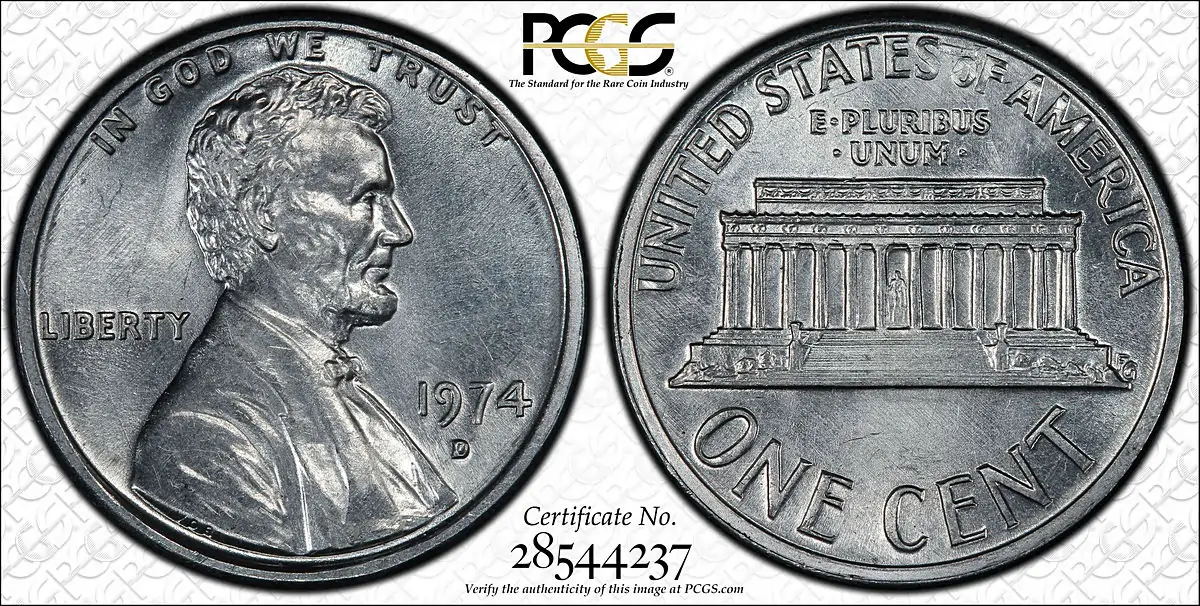
The Mint reacted at once. In February 2014, according to the Mint’s own account, it learned that the coin would go to auction and informed the owners that the Mint had never issued any aluminum one-cent pieces and had never transferred title to them. Coin World later reported that the coin left Heritage’s April 2014 Central States sale lineup shortly before the auction after the government asserted its claim. In other words, the coin did not fail to sell because bidders hesitated. It never reached the block.
The owners sued. They argued that Harry Edmond Lawrence, Randy Lawrence’s father and a former Denver Mint official, had lawfully kept the piece. In March 2015, Judge William Q. Hayes denied the government’s motion to dismiss. He did not rule that the plaintiffs owned the coin. Instead, he held only that their allegations, if taken as true at that stage, plausibly stated a claim. That distinction matters. The ruling kept the case alive, but it did not award title.
That settlement gave the Denver piece its final status. It did not become a legal rarity in private hands. It became a recovered government asset. So the most dramatic 1974 aluminum cent to surface in modern times ended not with a record hammer price, but with a return to federal custody.
Why the Mint Says It Is Illegal to Own a 1974 Aluminum Cent
Here the record turns tough, and it turns explicit.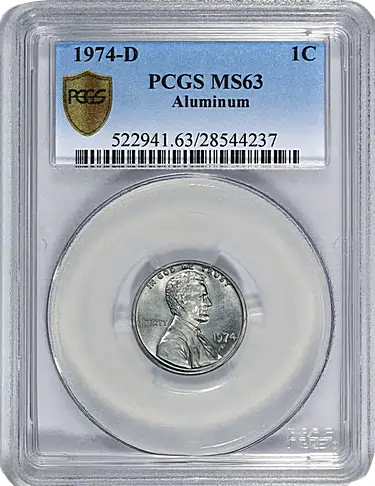
In a 2009 letter that surfaced in Treasury OIG records, Mint Chief Counsel Daniel Shaver stated the Mint’s position in plain language. He wrote that the Mint produced 1974-dated aluminum cents solely as experimental prototypes, that it never issued them, and that it had no lawful authority to issue them. He then stated that no one may lawfully circulate, sell, buy, or hold them because they remain property of the United States. The same investigative file also records that the government regarded recovery through the Secret Service as appropriate.
The Justice Department made the same point in the Denver case. It argued that no authorization existed for a Denver aluminum cent, that the piece left the Mint unlawfully, and that federal employees could not remove government property without proper authorization. The Mint’s 2016 press release broadened that principle beyond this single coin. It said that items made at Mint facilities but not lawfully issued, or otherwise lawfully disposed of, remain government property and are not souvenirs that employees may carry home and pass to heirs.
That legal theory explains the core paradox of the 1974 aluminum cent. Collectors see a pattern or experimental coin. The Mint sees unissued federal property. Those two views can overlap in hobby conversation, but they do not carry equal legal force. The Mint’s view controls when the government decides to act.
Have Any Been Legally Sold and Retained?
A true answer requires a distinction.
First, one institutional example clearly survives in legal hands. The Smithsonian holds a 1974 aluminum cent in the National Numismatic Collection. That piece sits inside a federal museum collection, not in the marketplace.
Second, one Philadelphia example has long remained in private hands according to PCGS. Yet the Mint’s formal position says no one may lawfully hold any true 1974 experimental aluminum cent. Treasury OIG records also show that investigators, at least in one 2009 inquiry, lacked enough evidence to move forward with a civil replevin action against certain missing pieces. That does not bless private title. It only shows that the government did not have enough evidence in that instance to recover those pieces through court. So the private Philadelphia example lives in a legal gray zone in public discussion, but not in a gray zone in the Mint’s stated legal theory.
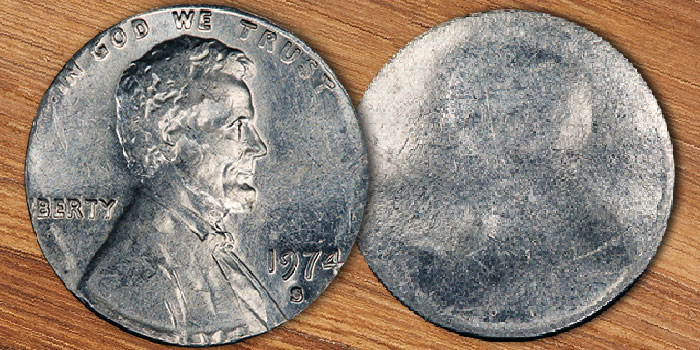
Third, a different coin muddies the waters if readers do not look closely. In January 2023, Heritage sold a 1974-S Lincoln cent struck on a Philippine aluminum sentimo planchet for $19,200. Heritage described that error as the only known 1974-dated aluminum U.S. cent that is legal to own. However, that piece is not one of the Philadelphia experimental aluminum cents and not the disputed 1974-D Denver piece. It is a separate mint error on foreign-planchet stock. Collectors need to keep those lanes separate.
So, if the question asks about true 1974 experimental aluminum cents, the clean answer stays harsh: no public case establishes a private auction sale that ended with an undisputed, legally settled private title to one of those coins. The Smithsonian piece survives in public institutional hands. The Denver piece went back to the Mint. And the privately held Philadelphia piece remains famous precisely because its status still invites argument.
Why This Story Still Grips the Hobby
The 1974 aluminum cent matters because it compresses everything collectors love into one object. It carries national policy, metal economics, congressional theater, medical testimony, Mint secrecy, and legal drama. It also forces a hard question. When does a coin become a collectible, and when does it remain government property forever? The 1974 aluminum cent never settled that question. It sharpened it.
That unresolved tension gives the coin its real power. Many American rarities became famous because collectors chased them. The 1974 aluminum cent became famous because the Mint chased it back. That reversal gives the story its sting. Usually, rarity creates desire. Here, prohibition created myth.
And that is the true wow factor. The 1974 aluminum cent did not simply vanish into history. It escaped into the halls of Congress, surfaced in the Smithsonian, haunted the hobby for decades, nearly reached a major auction, survived a federal lawsuit, and then returned to the Mint under a cloud that still hangs over every surviving piece. For a one-cent coin, few American stories carry more weight.
The post 1974 Aluminum Cent: The U.S. Mint’s Bold Penny Experiment, the Auction That Collapsed, and the Legal Fight That Still Haunts Collector appeared first on CoinWeek: Rare Coin, Currency, and Bullion News for Collectors.
from CoinWeek: Rare Coin, Currency, and Bullion News for Collectors https://ift.tt/Lhv80lp


