By Andrew Caldarone – Aegean Numismatics
A tiny countermark can move history and preserve a Roman army decision
Not literally. But sometimes it can move a chronology. Four small bronze coins with an “XV” stamp may push one group of Legion XV countermarks back to the Jewish War of AD 66–70. If the evidence holds, the coins add an earlier chapter to the story of Legio XV Apollinaris. They also challenge a long-standing second-century listing in Christopher Howgego’s standard catalog.
That is the “wow” factor. A mark only a few millimeters wide may preserve a Roman army decision made during one of the most violent moments in Judaea’s history.

Why Ancient Coins Were Countermarked
Countermarks appear on ancient coins for many reasons. One Greek city might stamp another city’s coins to approve them for local use. Bankers also marked some early Greek and Roman Republican silver and gold coins. Those marks helped signal acceptable metal, weight, or purity.
Politics also drove countermarking. Roman Imperial bronzes from the first century AD often carried political stamps. Some named emperors, such as TIB AVG for Tiberius Augustus. Others, such as NCAPR, remain debated. Collectors often connect NCAPR with Nero. Specialists have expanded it in more than one way, including Nero Claudius Augustus Probavit and Nero Claudius Augustus Populo Romano.
The civil wars of AD 68–69 added more tension. General history calls AD 69 the Year of the Four Emperors. Numismatic writers sometimes widen the lens and describe the broader crisis as a five-act imperial drama, from Nero’s fall through Vespasian’s victory.
Local bronze coinage also mattered. The Roman East produced a huge variety of civic and provincial issues. Collectors often call these Roman Provincial or Greek Imperial coins. Roman legions could countermark these local bronzes. Howgego argued that eastern legionary countermarks usually helped make worn bronze acceptable to troops as pay or change. He also noted that finds do not prove the coins became camp-only tokens.
Howgego’s Standard Framework
In 1985, Professor Christopher J. Howgego published Greek Imperial Countermarks: Studies in the Provincial Coinage of the Roman Empire. The work remains the standard reference for Greek Imperial countermarks. The Internet Archive metadata identifies it as Royal Numismatic Society Special Publication No. 17, published in London in 1985.
Howgego’s catalog places the legionary countermarks in the range 725–741. It includes countermarks of eastern legions such as III Cyrenaica, VI Ferrata, X Fretensis, XII Fulminata, and XV Apollinaris.
For Legion XV countermarks, GIC divides the evidence into three groups: 739, 740, and 741.
GIC No.ReadingHost CoinsChronology in GIC / Current Notes739LXV in rectangleBronze “as”-size hosts, about 8–12 g and 24 mm, from the Levant and southeastern Asia MinorGIC places these around Trajan’s eastern campaigns of AD 114–117, with possible continuation for a few years. Howgego cites Nicopolis, the SC series, Tiberian dupondii, Aradus, Neapolis, and uncertain hosts. 740LXV or XV in rectangleIssues of Caesarea, CappadociaGIC lists Lucius Verus, Marcus Aurelius, Hadrian, and Trajan host coins. It links the latest coins to Lucius Verus’ eastern expedition. 741Read as LXVACappadocian issue of TyanaGIC cites one Antoninus Pius host coin and notes the reading as likely LXVA, for Legio XV Apollinaris.
New evidence now sharpens that picture.
First, the evidence expands the likely date range for GIC 741. GIC cited one Antoninus Pius host. Research for this article identified 18 clear examples. Nine appear on host coins of Marcus Aurelius or Lucius Verus. That pushes the active use of the countermark well into the reign of Marcus Aurelius.
A logical start date would follow the legion’s return to Satala after Lucius Verus’ eastern campaign of AD 162–166. An earlier date would overlap with GIC 740. That overlap remains possible. However, it seems unlikely on current evidence.
A Needed Correction to GIC 740ii
GIC 740 has two subgroups. One is GIC 740i and reads LXV. And, GIC 740ii reads XV. Howgego cited four examples, plus a questionable fifth, but did not identify which cited coins belonged to 740i or 740ii.
A review of the source data changes the picture.
All cited examples appear to be LXV, or GIC 740i, with one exception. That exception is Dura 2070a from A. Bellinger’s catalog of the Dura-Europos excavations. Bellinger described it as a Hadrianic issue from Caesarea, Cappadocia, with an XV countermark. The coin did not appear on the book’s plates.
That matters because Dura-Europos has a deep Yale connection. Yale University and the French Academy sponsored major excavations at Dura-Europos in the 1920s and 1930s. Yale notes that the site lies near Salihiyah in modern Syria and that more than 12,000 excavated artifacts now help document life in the Roman city.
For this article, an image of the coin was located through the Yale University Art Gallery material. With the help of Benjamin Hellings, Jackson-Tomasko Associate Curator of Numismatics at Yale, the coin on the gallery site was confirmed as Dura 2070a. The countermark reads LXVA, not XV. Therefore, it belongs with GIC 741, not GIC 740ii.
Two more examples of GIC 740i with LXV also came to light: Henseler 505 and RPC Online Numismad Electronic Auction 11, lot 571. RPC Online also lists Henseler 426c and an S. Murphy Collection coin under GIC 740i, but those countermarks appear to read 741.
The conclusion follows. GIC 740ii appears to rest on an inaccurate Dura description. No documented example of an “XV” countermark on a second-century coin has yet been confirmed.
A Fourth Group: “XV” Countermarks from the Jewish War?
Four “XV” countermarks do exist. Yet they do not fit the GIC 740ii description.
They share different hosts, smaller weights, and a different geography. Most important, the host coins fit the first century BC through AD 69.
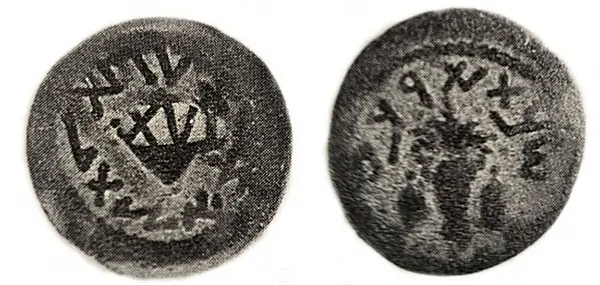
Example 1: Jewish War 1/8 Shekel, Year 4
The first host coin is a bronze 1/8 shekel of Year 4 of the Jewish War, dated AD 69. The type belongs to the First Jewish Revolt series. Standard examples weigh about 5.5 g and measure about 20 mm.
Hendin, Guide to Biblical Coins, sixth edition, lists the countermarked example as #6649 and notes it as unique. The countermark appears to read XVI. However, David Hendin explains that the left side of the apparent “I” is the edge of the rectangular punch.
The coin’s current location remains unknown to the contributors involved in this research. That prevents further examination for now.
Typical host size: 4.5–6 g, 18–20 mm.


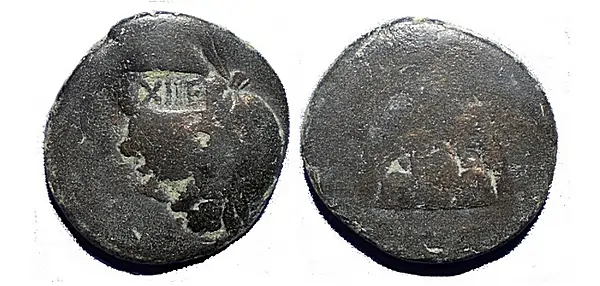
Example 2: Porcius Festus Prutah
The second host coin is a Judaean prutah of the Roman procurator Porcius Festus, struck under Nero in AD 58/59. CoinArchives records the type as a bronze prutah of Porcius Festus, Jerusalem mint, dated Year 5 of Nero, with references including Hendin GBC 6 #6380 and RPC I 4972.
Host reference: Hendin, Guide to Biblical Coins, sixth edition #6380
Weight and diameter: 3.0 g, 16 mm

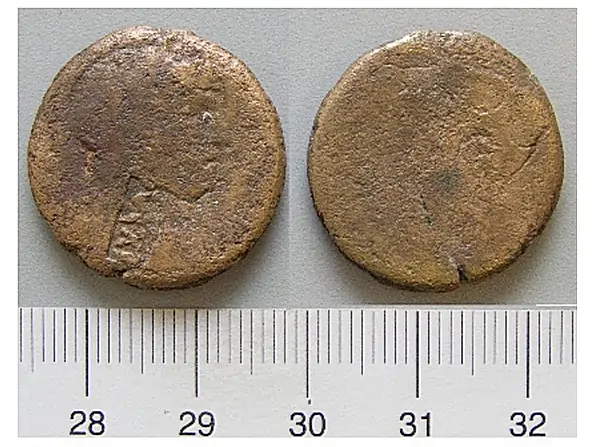
Example 3: Philomelium, Phrygia, Tiberius
The third host coin comes from Philomelium in Phrygia during the reign of Tiberius, AD 14–37. The British Museum records a Philomelium coin of Tiberius, dated AD 14–37, with SNG von Aulock 3918 as a reference.
Host references: RPC #3244; SNG von Aulock 3918
Weight and diameter: 4.5 g, 18 mm
This coin also carries Howgego 343, a Legion X countermark. That mark links the coin to Neapolis, Samaria, around AD 85.
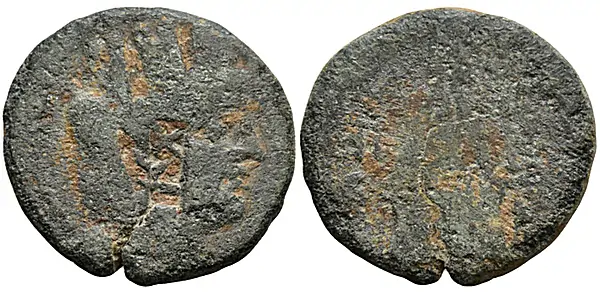
Example 4: Tarsus, Cilicia
The fourth host coin comes from Tarsus in Cilicia, circa 164–27 BC. Numista lists a Tarsos bronze of 164–27 BC with a diameter of about 21.5 mm and SNG France 1310–1311 references.
Host reference: SNG France 1310 type (?)
Weight and diameter: 5.7 g, 21 mm
Why These Four Coins Stand Apart
Several traits separate this group from GIC 739, 740, and 741.
First, all four hosts date from the first century BC to AD 69. That overlaps only partly with GIC 739. For this article, 11 examples of GIC 739 were located. Seven were struck on host coins issued after AD 69. The four earlier hosts show heavy wear, usually Poor to Good.
GIC 740 and 741 differ even more. It remains uncommon to find those countermarks on host coins earlier than Trajan, who ruled from AD 98 to 117. That pattern points away from a second-century date for the four “XV” coins.
Second, all four “XV” coins weigh between 3 and 6 g. That is about half the weight of the “as”-size hosts usually seen with GIC 739–741.
This size matters. Legion X countermarked many small bronze coins in the second half of the first century at its base of Neapolis, Samaria. One of the four “XV” coins also carries the Legion X countermark GIC 343, applied around AD 85.
We cannot prove which countermark came first. Still, the Legion X mark confirms that the Philomelium coin reached the Judaea region in the second half of the first century. That supports the same regional setting for Legion XV.
Third, GIC 740 and 741 appear only on Cappadocian issues. None of the four “XV” coins comes from Cappadocia. Instead, the group runs from southern Asia Minor to Judaea. That geography resembles GIC 739 more closely than GIC 740 or 741.
The Legion’s Movements Narrow the Date
The history of Legio XV Apollinaris narrows the possible windows.
The legion spent much of the early first century at Carnuntum, downstream from modern Vienna. Nero then sent it to Syria in AD 62 or 63 during the wider eastern crisis. After that Parthian war, the legion went to Alexandria. Soon, the Jewish War began. Livius records that XV Apollinaris served under Titus, helped take Jotapata and Gamala, and returned to Carnuntum in AD 71 after the war.
The legion returned east under Trajan. In AD 115, it fought in Mesopotamia during Trajan’s Parthian War. After Trajan’s death, Rome reorganized the eastern frontier, and XV Apollinaris remained at Satala in northeastern Cappadocia. In AD 134, Arrian of Nicomedia used XV Apollinaris and XII Fulminata against the Alans. In AD 162–166, the legion joined Lucius Verus’ campaign against the Parthians.
That leaves three plausible Levant or Syria-area windows for the “XV” group:
- AD 67–70, during the Jewish War;
- AD 115–about 120, during and after Trajan’s eastern campaigns;
- AD 162–166, during Lucius Verus’ eastern campaigns.
The host coins favor the earliest window.
Wear, Circulation, and the Strongest Clue
Condition adds another layer.
Older host coins with GIC 739–741 usually show extreme wear. Some approach cull condition. The older “XV” hosts in examples 3 and 4 were already about 35 and 100 years old, respectively, if countermarked during the Jewish War. They show about Good condition, which fits long circulation.
By contrast, the two Judaean examples look much better. That matters. If the Jewish War 1/8 shekel entered circulation in AD 69 and then received its countermark in AD 115, it would already have been about 45 years old. We would expect more wear. The Porcius Festus prutah would also have been decades old by Trajan’s eastern campaigns.
Of course, coins can leave circulation and later return. That may have happened. Yet the simpler explanation places the countermark closer to the coins’ own circulation life.
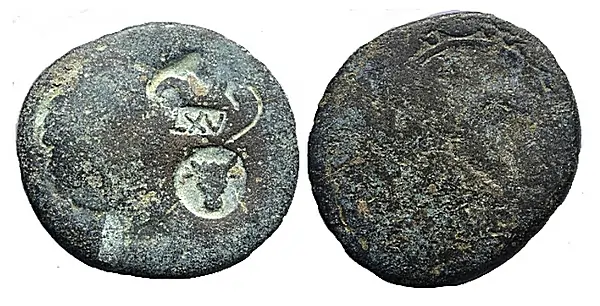
One comparison sharpens the point. A GIC 741 coin from Dura circulated from roughly AD 120 to AD 180. It remains identifiable mainly from Hadrian’s profile. Another GIC 739 example, shown below, began as an Antioch issue of Augustus around AD 25. Legion XV countermarked it around AD 115. The LXV countermark lies over GIC 503, which Howgego places in the late first century at Edessa or Dura. That host had circulated for about a century.
The Judaean “XV” coins do not look like that. Their condition points toward a shorter life in circulation.
A Critical Caveat: The Year 4 1/8 Shekel
One question deserves special attention.
Professor Howgego has suggested that the Year 4 1/8 shekel may have been struck over a worn coin that already carried an “XV” countermark. He based this on the lack of obvious flattening on the reverse. If that view proves correct, the early date would become much stronger. The countermark would have to predate AD 69.
David Hendin has doubts. He notes that he does not know of Jewish War Year 4 coins struck over earlier coins. The flan also has the typical tapered shape and appears to fit the correct size for a 1/8 shekel, a denomination not struck before the war.
An Egyptian cull host remains possible, since Egypt also used tapered flans. Yet that seems unlikely. Judaean forces also would have had reason to obliterate a visible reference to Legion XV. Since the coin’s current location remains unknown, further examination cannot proceed.
The Best Current Theory
The best current theory places the early “XV” countermark group in the Jewish War of AD 66–70.
That conclusion rests on several linked facts. The host coins predate AD 70. The Judaean examples remain too fresh for an easy second-century placement. The weights fit small first-century bronze circulation. The geography points to Judaea and the nearby eastern provinces. Finally, Legion XV served in the Jewish War under Titus.
If a future edition of GIC adds this group, 738a would make sense as the new catalog position. It would sit before the established Legion XV countermarks 739–741.
However, new evidence could change the picture. A clear “XV” countermark on a later imperial host would shift the argument toward Trajan’s eastern campaigns and GIC 739. For now, no such example has surfaced.
That is why these four small bronzes matter. They do more than carry a stamp. They may carry the earliest known numismatic trace of Legio XV Apollinaris in Judaea.
References and Footnotes
- Christopher J. Howgego served as Acting Keeper of the Heberden Coin Room in 2005 and Keeper from 2006 to 2023. Oxford and the Ashmolean list him as an Honorary Curator / Emeritus scholar in Greek and Roman numismatics.
- C.J. Howgego, Greek Imperial Countermarks: Studies in the Provincial Coinage of the Roman Empire, Royal Numismatic Society Special Publication No. 17, London, 1985.
- A. Bellinger, The Excavations at Dura-Europos, Final Report VI: The Coins, New Haven, 1949. Yale notes that Dura-Europos lies near Salihiyah in modern Syria and that Yale and French teams sponsored the major 1920s–1930s excavations.
- Additional GIC 740i examples: Henseler 505 and RPC Online Numismad Electronic Auction 11, lot 571. RPC Online entries for Henseler 426c and an S. Murphy Collection example appear to belong under GIC 741.
- Hendin discussion of the Jewish War Year 4 1/8 shekel: current location unknown; further physical study needed.
- Legion X countermarks on small bronze coins: Rosenberger, The Coinage of Eastern Palestine & Legionary Countermarks, Bar-Kochba Overstrucks, 1978, p. 80, nos. 10–12; CNG Electronic Auction 421, lot 368; Hendin, Guide to Biblical Coins, sixth edition, nos. 6642–6643.
- Nigel Pollard and Joanne Berry, The Complete Roman Legions, Thames & Hudson, London/New York, 2012.
- Stephen Dando-Collins, Legions of Rome, St. Martin’s Press, New York, 2010, pp. 313–319.
The post Legion XV Countermarks: New Evidence Points to the Jewish War appeared first on CoinWeek: Rare Coin, Currency, and Bullion News for Collectors.
from CoinWeek: Rare Coin, Currency, and Bullion News for Collectors https://ift.tt/pDBj4Er


