The Lincoln Cent That Nearly Changed Forever
In 1952, the Lincoln cent nearly took a bold new direction.
The artist behind that proposed change was James Earle Fraser, one of America’s most important coin designers. Collectors know Fraser best for the Buffalo nickel. However, his work also shaped many commemorative coins. Late in his career, Fraser offered the United States Mint a fresh vision for the nation’s one-cent coin.
He did not wait for a formal competition. Instead, in December 1951, Fraser sent unsolicited obverse and reverse designs to U.S. Mint Director Nellie Tayloe Ross. His proposal reimagined both sides of the Lincoln cent.
Ross immediately saw the power of the designs.
After she viewed the plaster models, she wrote that she felt a “real thrill of admiration and appreciation” for Fraser’s art. She also praised Fraser’s Lincoln portrait and called it “incomparably better” than the portrait then used on the one-cent piece.
That reaction matters. Ross did more than offer polite praise. She championed the design inside the Treasury Department. As a result, the Mint struck pattern cents in 1952.
Then the project vanished.
James Earle Fraser’s New Lincoln Cent
Fraser’s proposed obverse showed a large portrait of President Abraham Lincoln. The portrait had a direct artistic connection to Fraser’s earlier work. It resembled his 1911 Lincoln design.
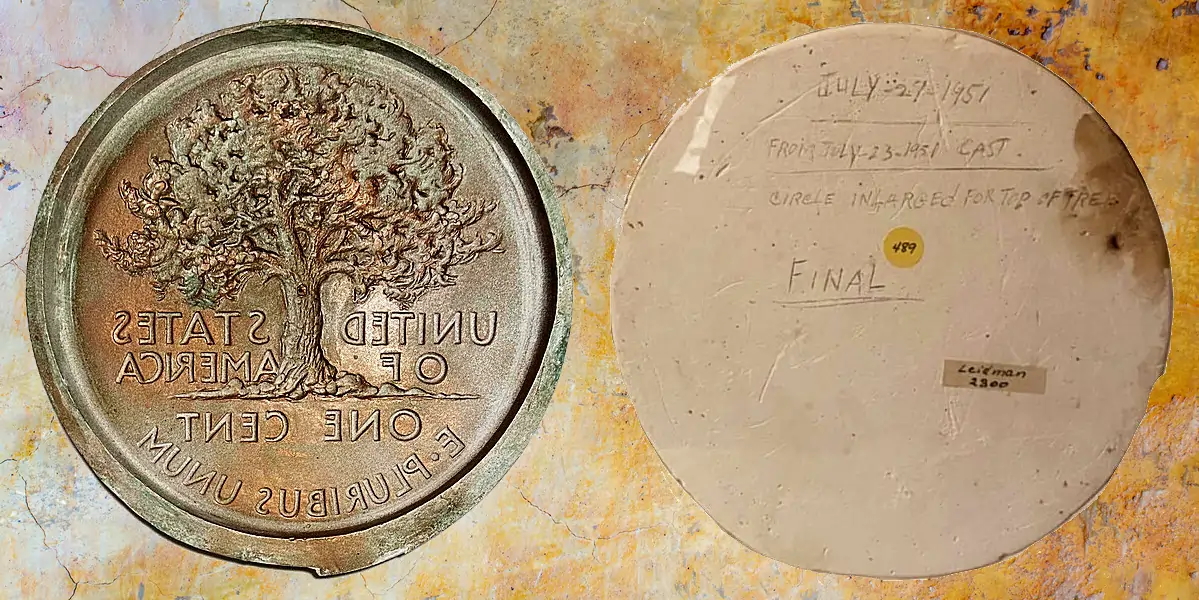
The reverse carried even deeper symbolism. Fraser chose an oak tree.
That choice gave the design a rare place in American coinage history. At that time, an oak tree had appeared on only one United States coin: the 1935 Connecticut Tercentenary half dollar.
Director Ross understood the symbolism. In a letter, she explained that the oak suited Lincoln because he had been a woodsman. She also linked the tree to strength, renewal, and national unity.
Ross wrote that the oak stood for “strength, ever renewing growth, and unity.” She then compared the tree to a nation, with roots, a trunk, branches, flowers, and fruit.
That symbolism gave Fraser’s reverse a distinctly American voice. It connected Lincoln’s frontier identity to the growth of the Republic. Moreover, it gave the cent a design language that reached far beyond a simple denomination.
The Pattern Cents of 1952
Ross persuaded the Secretary of the Treasury to authorize pattern coins with Fraser’s designs.
The Mint struck the first group on May 7, 1952. That production totaled 46 pattern cents.
Then the Mint struck a second group on June 19, 1952. That later group totaled 100 pattern cents. The Mint used modified dies for the second striking. Those dies carried a slightly lower relief.
In total, the Mint produced 146 pattern cents for the Fraser Lincoln cent project.
Yet the design never reached circulation. Despite Ross’s support and early enthusiasm, the Mint did not adopt the new Lincoln cent.
A Canceled Coin and a Lost Design
The project ended in March 1953.
On March 16, 1953, Mint officials certified the destruction of all 146 pattern cents. Mint staff then locked the dies in the Engraver’s safe. The Philadelphia Mint placed the plaster models in storage.
That sequence gives this object its remarkable backstory.
Fraser created a serious design proposal. The Mint struck real pattern coins. The Director of the Mint admired the work. Treasury officials allowed test pieces. Then the government destroyed the coins and stored the models away.
For collectors, that chain of events creates a rare kind of drama. This is not just an unused design. It is a surviving witness to a Lincoln cent that almost happened.
The 10½-Inch Reverse Plaster Model
The object offered here is the reverse plaster model for Fraser’s 1952 cent pattern.
It measures 10½ inches and takes the form of a negative plaster model. It shows Fraser’s oak tree reverse design
.
The model has survived its roughly 75-year history in excellent condition. It consists of white alabaster plaster with bronze and green powder coating.
The back of the plaster adds important production evidence. Notations state that the model dates to July 27, 1951. Those same notes show that it came from a July 23, 1951 cast. They also identify it as the FINAL model.
That final-model notation gives the piece special importance. It shows that Fraser’s reverse had moved beyond a rough concept. It represented the finished design submitted for serious Mint consideration.
The Fivaz Photograph and the Missing Obverse
The obverse side has its own mystery.
In 1995, numismatist Bill Fivaz photographed the obverse design. However, the surviving record does not clearly state whether he photographed a galvano or a plaster model.
That uncertainty adds another layer to the story. The reverse plaster model remains a tangible survivor. Meanwhile, the status and nature of the obverse model remain less clear.

Why Collectors Prize Plasters and Galvanos
Collectors have paid growing attention to Mint plasters, casts, and galvanos. Their appeal has increased sharply in recent years. Their rarity also drives demand.
Several major sales show that trend.
A Buffalo Nickel galvano sold for $180,000 in a Stack’s Bowers auction. A 1921 Peace Dollar bronze cast of the reverse brought $132,000 in a Heritage auction. Also, a set of Long Island Half Dollar plaster and galvanos sold for $63,000 in a Heritage auction.
These results show a clear market shift. Collectors no longer view these objects only as production tools. Instead, they see them as original sculptural artifacts. They also connect buyers directly to the creative process behind American coinage.
Unique in Private Hands
This 1952 Cent Pattern plaster model stands apart.
It is considered unique in private hands. It also belongs within the highest level of Fraser-related numismatic material.
The model would fit naturally in a museum. It would also anchor a major private collection focused on James Earle Fraser coin designs, Lincoln cent patterns, or United States Mint design history.
Pedigree
The plaster model carries a notable ownership record.
Its pedigree traces to The Fraser Estate. It later appeared in Joseph L. Lepczyk’s Sale No. 36, held October 23-24, 1980, as Lot 489. It then appeared in Numismatic Auctions LLC’s June 2018 Sale No. 62, as Lot 1018. After that, it entered a Private Collection. It later passed through Andy Lustig and then Mike Byers.
A Surviving Relic of a Coin That Never Was
The 1952 Fraser cent pattern tells a powerful American coinage story.
It begins with one of the nation’s great sculptors. It moves through the office of Nellie Tayloe Ross. It reaches the Treasury Department. Then it enters the Philadelphia Mint, where pattern cents came to life for a brief moment.
Finally, the struck cents disappeared. Officials certified their destruction. The dies went into a safe. The plaster models went into storage.
Yet this reverse plaster survived.
Because of that, collectors can still see Fraser’s oak tree as Ross saw it. They can also imagine a Lincoln cent that might have carried a symbol of strength, renewal, and unity into American pockets.
That is the “wow” factor. This is not only a plaster model. It is the last visible chapter of a serious Mint effort to replace the familiar Lincoln cent design with one created by the designer of the Buffalo nickel.
The post James Earle Fraser’s Lost 1952 Lincoln Cent Pattern Reverse appeared first on CoinWeek: Rare Coin, Currency, and Bullion News for Collectors.
from CoinWeek: Rare Coin, Currency, and Bullion News for Collectors https://ift.tt/01TgKs3


