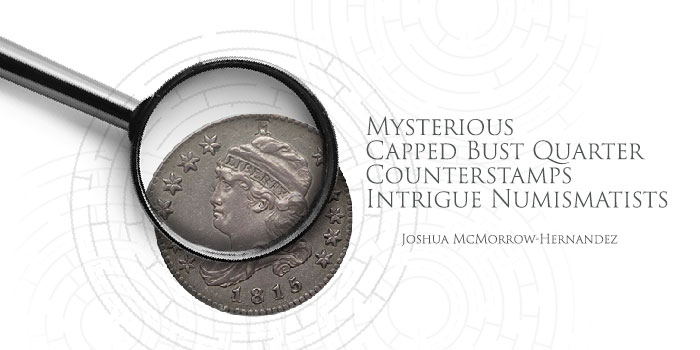
The Tiny “E” and “L” Counterstanps That Turned Two Early U.S. Quarters Into a 140-Year Mystery
By Joshua McMorrow-Hernandez for PCGS ……
Originally based on reporting by Joshua McMorrow-Hernandez for PCGS, with additional CoinWeek research.
Among early Federal-era United States coins, few pieces create more questions than the 1815 and 1825 Capped Bust quarters counterstamped with a single “E” or “L”. The marks look simple. Yet the story behind them remains one of the great unsolved puzzles in American numismatics.
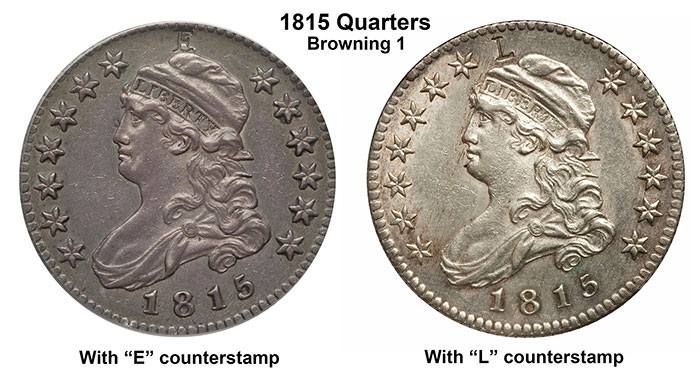
Collectors know four basic combinations: the 1815 “E”, the 1815 “L”, the 1825 “E”, and the 1825 “L”. The group first appeared in the numismatic record in August 1881. Since then, researchers have debated whether the counterstamps came from the Mint, a private party, a school, a bank, a religious community, or someone with no official purpose at all.
A Small Letter With a Big Mystery
The mystery starts with placement. Each counterstamp appears above Liberty’s head on the obverse. The “E” and “L” punches look alike from coin to coin. However, their exact positions vary slightly. That detail suggests the same person may have stamped the coins at roughly the same time. Still, it does not prove it.
For decades, many collectors assumed the letters had a government origin. More recent scholarship, however, leans toward a post-mint explanation. That shift matters. If the Mint applied the marks, the coins would represent an official experiment or control system. If someone else applied them later, they become a different kind of artifact: a private mark on already-struck Federal coinage.
Either way, no known Mint document explains them. Therefore, the coins remain silent witnesses.
Why Only 1815 and 1825?
The dates raise another problem. The counterstamps appear on quarters struck 10 years apart. Yet researchers do not know them on quarter-dollar issues from the intervening years. Also, the marks appear on only one die marriage for each date.
That point matters. PCGS CoinFacts notes that every known 1815 Capped Bust quarter came from a single die marriage, Browning-1. So the 1815 side of the puzzle fits neatly.
The 1825 issue creates a sharper question. The date used three die marriages, but the counterstamped examples appear only on the B-2 die marriage. PCGS lists the 1825/4/(2) B-2 “L” counterstamp as a recognized Capped Bust quarter variety.
That narrow pattern suggests selection. However, it does not reveal motive.
“E” and “L” Counterstamps: Damage or History?
Many counterstamped coins bring little excitement. Collectors often treat them as damaged or altered. Yet some counterstamps tell a clear story.
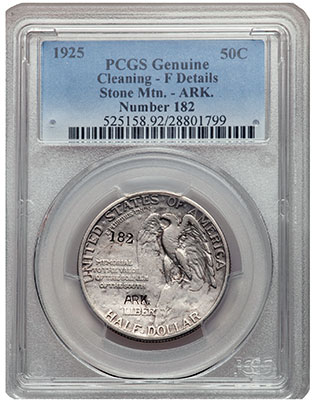
For example, the 1925 Stone Mountain Memorial half dollars include known counterstamped pieces connected to a promotional fundraising campaign. The American Numismatic Association notes that the Stone Mountain issue supported the monument project, while PCGS describes counterstamped examples with state abbreviations, numbers, and other sales-related markings.
The “E” and “L” quarters offer no such clarity. They carry no merchant name. They name no town. They show no obvious political slogan, advertising message, or commemorative purpose. As a result, collectors must weigh clues rather than answers.
The Theories Behind the “E” and “L”
In 1921, Dr. Frank G. Duffield proposed that the “L” stood for “light,” perhaps identifying underweight coins. One “L” example had even appeared in a catalog as a Proof. Later, during the 1950s, other researchers still argued for a Mint-made explanation. Yet that line of research failed to produce confirming Mint records.
Then, in 1982, Walter Breen suggested a school-prize theory. In that explanation, “E” meant English and “L” meant Latin. Breen also reasoned that the coins survive in high grades because recipients kept them as mementos rather than spending them.
Steve Tompkins summarized still more theories in Early United States Quarters, 1796-1838. Some proposals place the letters inside the Mint and connect them to press settings. In those readings, the letters could mean “even,” “excess,” “left,” or “light.”
Another popular theory points to the Harmonist community in Economy, Pennsylvania. Under that interpretation, the quarters may have served as voting counters in the 1830s.
Then come the more colorful ideas. One theory ties the “L” to Mint Director Henry Linderman and the “E” to Mint employee Theodore Eckfeldt. It claims the coins helped account for revenue from illicit pattern-coin sales. Another theory connects the marks to surplus coins shipped to a Louisiana bank.
However, every major theory has problems. The evidence still falls short. Therefore, the safest conclusion remains simple: the origin of the “E” and “L” counterstamps remains unproven.
Could the Answer Be Ordinary?
Collectors love a grand explanation. Yet numismatic history sometimes delivers a simpler answer.
Someone may have had access to a small group of 1815 and 1825 quarters. That person may also have had “E” and “L” punches nearby. Then, for reasons now lost, that person marked the coins. The identical-looking letters and similar placement support a common source. Still, the slight positional differences show that each coin received its mark separately.
That ordinary explanation may feel unsatisfying. However, it also fits the missing-paperwork problem. No Mint record. No bank record. No school record. No newspaper article. Not yet.
Why Collectors Still Chase Them
The “E” and “L” counterstamped quarters matter because they combine rarity, early U.S. coinage, die-variety study, and mystery. PCGS began certifying these pieces with numerical grades while noting the counterstamp in August 2019, which helped place them more clearly inside the certified market.
PCGS Director of Numismatic Education & Outreach Steve Feltner has described the mystery as part of their appeal. In his view, the true story may never surface. Even so, the coins retain historical importance and collector demand.
David Perkins of the John Reich Collectors Society has made a similar point. Counterstamp collectors usually prefer pieces with clear merchant names, initials, locations, or advertising. These quarters break that pattern. They carry only one letter. Yet they still command attention because they have a story to tell.
Collecting the Four-Coin Set
Most known examples grade XF or better, according to Perkins’s long experience with the series. He has noted at least one VF30 example, but lower-grade coins appear unusual. If the pieces had circulated widely after stamping, collectors would likely see more examples in VF and below.
A complete four-piece set includes:
- 1815 “E” counterstamp
- 1815 “L” counterstamp
- 1825 “E” counterstamp
- 1825 “L” counterstamp
The set looks simple on paper. In practice, it demands patience and money. Perkins has said only a small number of collectors appear to own all four. Cost likely explains much of that scarcity.
PCGS’s 2019 market snapshot placed lower Mint State 1815 “E” quarters around $4,000 to $6,000, while 1815 “L” examples brought about $3,000 to $5,000. The somewhat more available 1825 “E” and “L” examples often traded around $2,500 to $4,000 in lower Mint State grades.
Recent public sales show that price levels can vary widely by grade, surface quality, and timing. For example, PCGS reports a September 2025 Stack’s Bowers sale of an 1815 B-1 “E” counterstamp graded AU-58 by PCGS for $5,160. PCGS also reports a September 2025 Stack’s Bowers sale of an 1825/4/2 B-2 “L” counterstamp graded MS-63 by PCGS for $13,200.
Which Letter Is Scarcer?
Available sales data suggest that “E” countermarks appear more often than “L” countermarks overall. The pattern also differs by date. The “E” appears more often on 1815 quarters, while the “L” appears more often on 1825 quarters.
That uneven distribution adds another layer to the mystery. If someone stamped the coins for a structured purpose, why do the letters divide that way? If the markings came from a random act, why do the known survivors form such a tidy four-part collecting challenge?
Those questions keep the coins alive in specialist circles.
The Document That Could Solve Everything
The best evidence may still sit in an archive. Perkins has argued that the odds of solving the mystery may improve as old newspapers, catalogs, and records move online. A single late-19th-century newspaper notice about “curious counterstamps” could change the entire story.
Until then, the “E” and “L” Capped Bust quarters remain exactly what collectors love: rare, strange, early, and unresolved.
More than 140 years after their first documented auction appearance, these small letters still do big work. They turn two early silver quarters into numismatic riddles. They connect collectors to the limits of the written record. And they remind us that American coinage still holds secrets in plain sight.
The post Mysterious “E”, “L” Counterstamps on Capped Bust Quarters Intrigue Numismatists appeared first on CoinWeek: Rare Coin, Currency, and Bullion News for Collectors.
from CoinWeek: Rare Coin, Currency, and Bullion News for Collectors https://ift.tt/TfcOv56


