How a Wartime Mint Mix-Up Created a $120,000 Dime
A single dime can tell a surprisingly large story.
The 1942/1 Mercury dime carries two dates. It also connects the wartime economy, old Mint technology, a hurried engraving department, and one of the greatest circulation finds of the 20th century.
Yet collectors often misunderstand how the error happened.
No Mint employee punched a “2” over a “1.” The Mint did not strike a finished 1941 dime again with 1942 dies. Instead, workers created an obverse die with impressions from two different dated hubs.
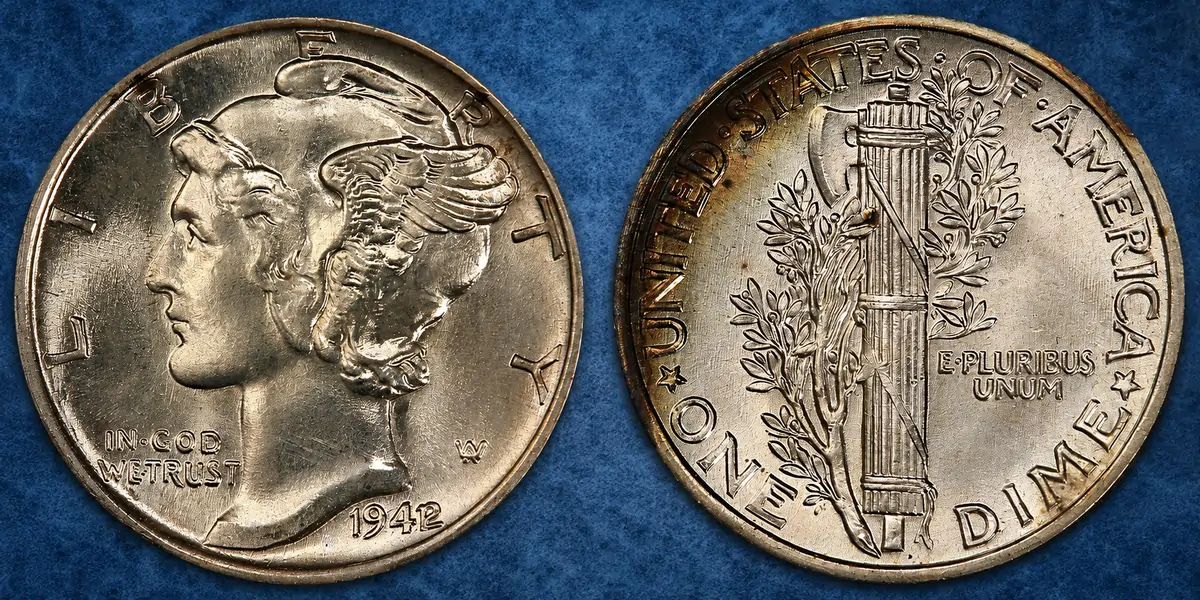
Even more remarkably, the same mistake happened twice. One working die remained in Philadelphia. The other traveled to Denver.
Together, those dies created the famous 1942/1 and the much more elusive 1942/1-D Mercury dimes.
The Mercury Dime Entered the War Years

Sculptor Adolph A. Weinman designed the Winged Liberty Head dime, which collectors quickly nicknamed the Mercury dime. Liberty wears a winged cap that symbolizes freedom of thought. Meanwhile, the reverse combines a fasces with an olive branch. Those devices represent strength through unity, military readiness, and the desire for peace.
That symbolism carried added weight by 1941.
The United States had shifted enormous industrial resources toward national defense. As a result, commerce demanded more coins. The Philadelphia Mint also had to prepare working dies for several facilities while maintaining current-year production.
During the final months of 1941, the engraving department worked with both 1941- and 1942-dated Mercury dime hubs. Philadelphia reportedly began preparing 1942 working dies as early as September. However, the Mint still needed additional 1941 dies through the end of the year.
That overlap created the conditions for a historic mistake.
How the 1942/1 Mercury Dime Error Happened
The Mint’s die-making process required more than one hubbing impression.
First, a working hub pressed the coin’s design into a blank working die. Mint employees then softened or annealed the die before the next impression. The second hubbing brought the design to full depth. Afterward, the Mint hardened the finished die for service.
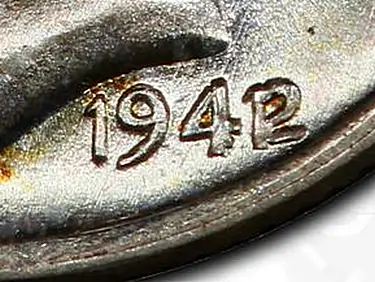
However, two Mercury dime dies received mismatched impressions.
A 1941-dated hub created the first impression. Then, a 1942-dated hub delivered the second. Consequently, traces of the 1941 date remained beneath the stronger 1942 date.
One defective die stayed at the Philadelphia Mint. The other went to the Denver Mint. Each facility then used its die to strike an unknown number of dimes.
Several years later, Mint Director Nellie Tayloe Ross acknowledged that a die may have received one impression from a 1941 hub before workers accidentally finished it with a 1942 hub. Her explanation supports the dual-hub origin that specialists accept today.
Therefore, the familiar “overdate” name tells only part of the story. Technically, the coins represent Class III doubled dies created from hubs with different dates.
The Date Really Reads 1942 Over 1941
Collectors call the Philadelphia variety the 1942/1 Mercury dime. However, specialists often describe it more accurately as the 1942/41.
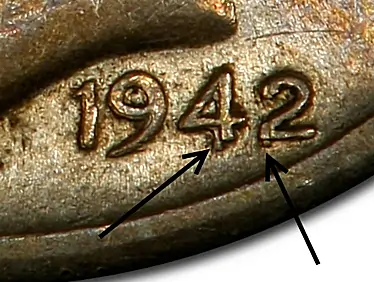
The underlying “1” beneath the final “2” creates the most dramatic feature. Still, the rest of the date also shows evidence of the earlier hub. In particular, the “4” displays strong doubling and a distinctive notch.
The Philadelphia variety shows these features boldly. Therefore, collectors can often recognize a circulated example without powerful magnification.
The Denver variety presents a much greater challenge. Its underlying date appears fainter. Moreover, the weaker visual separation allowed nearly every known example to circulate before collectors understood what they had missed.
PCGS also identifies additional diagnostics on the Philadelphia die. These include doubling on parts of IN GOD WE TRUST and the “Y” in LIBERTY. Die-polish lines near the date, Liberty’s neck, and the reverse fasces can provide further confirmation.
A Circulation Find Became an Instant Sensation
A Kingston, New York, collector named Arnold Cohn found the Philadelphia overdate in circulation. Some modern references spell his surname “Kohn,” but contemporary and later auction accounts also record it as Cohn.
Cohn reported the discovery to The Numismatic Scrapbook Magazine. The publication announced the variety in March 1943. Then, editor Lee F. Hewitt sent the coin to Chief Engraver John R. Sinnock for an explanation.
The magazine published Sinnock’s comments and the first photographs in May 1943. Collectors immediately began searching pocket change, bank rolls, and dealer inventories. By 1945, major numismatic references had added the variety.
The Philadelphia overdate had therefore gained national attention barely a year after its release.
Even so, most surviving pieces show circulation wear. PCGS notes that collectors found 166 examples in the famous New York Subway Hoard. Walter Breen also reported that many known Uncirculated pieces came from four original rolls discovered in 1954.
Denver Hid Its Secret for Nearly Two Decades
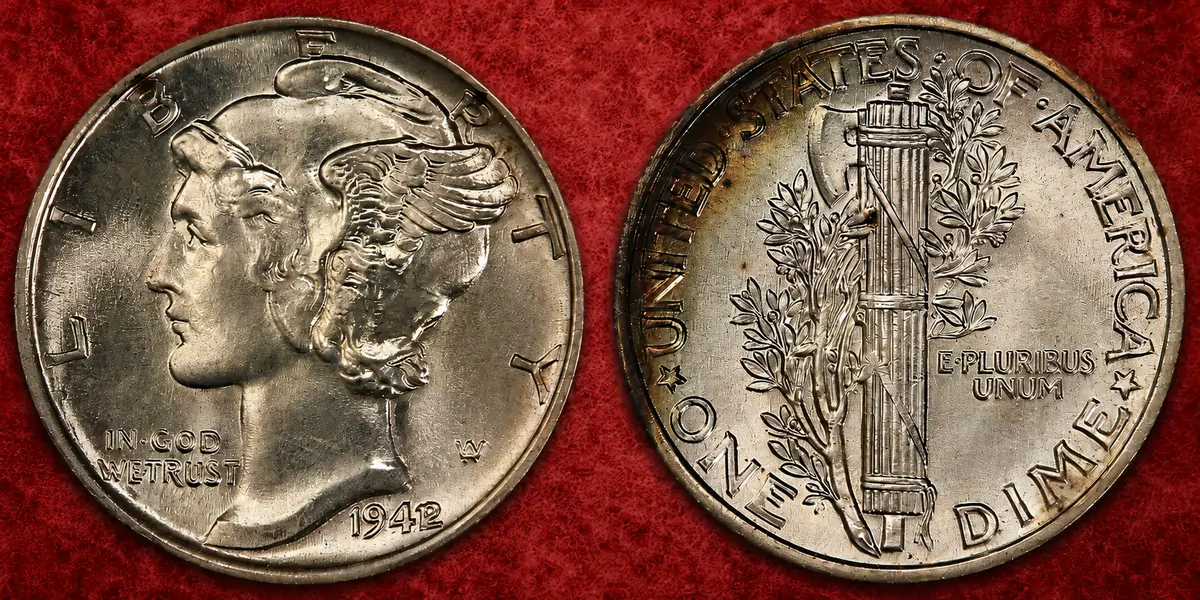
The 1942/1-D followed a very different path.
Its subtle date failed to attract widespread attention during the 1940s. Numismatic researcher David W. Lange later located an anonymous report in the November 1960 issue of The Numismatic Scrapbook Magazine. That report described a 1942/1 dime that also carried a Denver mintmark.
Delma K. Romines independently identified and widely publicized the Denver variety in 1962. Auction catalogs often credit Romines with its discovery because his work brought the coin to the broader collecting community.
By then, almost every example had spent years in circulation. Consequently, collectors usually encounter the 1942/1-D in Very Fine or Extremely Fine condition.
Mint State coins tell a different story. They rank among the leading condition rarities in the entire Mercury dime series.
Which 1942/1 Mercury Dime Is Rarer?
The Denver issue wins the overall rarity contest.
PCGS currently estimates that about 3,500 Philadelphia examples survive in all grades. The service estimates roughly 3,000 survivors from Denver. Therefore, the numerical difference looks modest at first.
However, the gap expands dramatically in Mint State.
PCGS estimates approximately 200 Philadelphia coins survive in MS60 or better. It places the Denver total at only 20. At the Gem MS65 level, PCGS estimates 30 Philadelphia survivors and just 10 Denver pieces. These figures remain estimates rather than documented Mint totals, but they clearly illustrate the Denver coin’s conditional rarity.
The comparison changes again when collectors demand Full Bands.
PCGS estimates only about 75 Philadelphia Full Bands examples across all qualifying grades. In contrast, it estimates about 200 Full Bands survivors from Denver. At MS65 or better, the estimates stand at 30 for Philadelphia and 60 for Denver.
Therefore, the answer depends on the coin.
The 1942/1-D ranks rarer overall and far rarer in ordinary Mint State. However, the Philadelphia issue becomes rarer with the Full Bands designation.
Why Full Bands Changes Everything
The Mercury dime reverse shows three groups of bands wrapped around the fasces. PCGS awards its Full Bands, or FB, designation when the central bands show complete, uninterrupted separation from left to right.
Marks, cuts, or gaps can prevent a coin from qualifying. PCGS normally restricts the designation to Mint State dimes. However, it makes exceptions for the 1916-D, 1942/1, and 1942/1-D because those issues carry extraordinary rarity and collector interest.
Philadelphia produced the more dramatic overdate. Yet its coins often show weaker central detail. As a result, fully separated bands remain exceptionally difficult to find.
Denver produced fewer surviving Mint State overdates. However, the surviving coins often display sharper strikes. Therefore, a larger percentage of Mint State Denver pieces qualify for Full Bands.
This creates one of the most fascinating rarity reversals in American coinage. The Denver coin remains much tougher in Mint State, but the Philadelphia coin becomes the greater Full Bands challenge.
The Finest Coins and the Auction Records
Top-grade examples occupy different categories. Therefore, collectors should not combine the regular Mint State and Full Bands records.
PCGS lists a 1942/1 graded MS67+ as the leading non-Full Bands Philadelphia example. The coin had previously appeared in an NGC MS68 holder. It realized $90,000 at Heritage’s January 2023 FUN auction.
However, the Philadelphia Full Bands auction record stands even higher. A PCGS MS66FB example brought $120,000 at Heritage’s January 2018 FUN auction. That price remains the PCGS CoinFacts auction record for the issue with Full Bands.
For Denver, PCGS displays an MS67FB coin at the top of its condition census. That specimen has appeared at auction several times, including a $57,500 sale in 2011. Meanwhile, the PCGS CoinFacts auction record belongs to an MS66+FB example that realized $73,438 at Legend Rare Coin Auctions in May 2019.
These results show how strongly collectors value the complete package. A bold overdate matters. Yet pristine surfaces, original luster, sharp central details, and uninterrupted bands can turn a rare dime into a six-figure trophy.
Beware of Altered 1942/1 Mercury Dimes
The 1942/1 ranks alongside the 1955 Doubled Die Lincoln cent and the 1937-D Three-Legged Buffalo nickel as one of America’s most recognizable varieties.
Naturally, that fame attracts counterfeiters.
Altered dates appear regularly in the marketplace. Some individuals modify ordinary 1942 dimes to imitate the underlying “1.” Others may add or strengthen details around the date.
A genuine coin must match the known die characteristics. The shape of the “2,” the doubled “4,” the position of the underlying digits, and the associated die markers all matter. Therefore, collectors should avoid relying on one suspicious line beneath the final digit.
For expensive examples, third-party authentication offers essential protection. PCGS specifically warns collectors about altered dates on this issue.
Two Dimes, One Mistake, and a Lasting Mystery
The 1942/1 Mercury dimes do more than fill two difficult spaces in an album.
They preserve a moment inside the Philadelphia Mint’s engraving department. Workers had two dated hubs in service. A pair of dies crossed from one production year into the next. Then, one die stayed home while the other traveled west.
No surviving production record tells us how many overdates each die struck. Moreover, no document identifies the employee who switched the hubs. The coins themselves provide the evidence.
That uncertainty gives the varieties their lasting power.
The bold Philadelphia coin announced the mistake to collectors during the war. The quieter Denver coin hid in circulation for nearly two decades. Today, one offers the greater visual drama. The other delivers the tougher Mint State challenge.
Together, they form one of the most compelling matched pairs in American numismatics.
The post 1942/1 Mercury Dime: The Wartime Mint Mistake That Put Two Years on One Coin appeared first on CoinWeek: Rare Coin, Currency, and Bullion News for Collectors.
from CoinWeek: Rare Coin, Currency, and Bullion News for Collectors https://ift.tt/xWMOhNm


