The Wartime $1 Experiment Collectors Refused to Spend
The large red letter immediately catches the eye.
It sits beside the blue Treasury seal on an otherwise familiar Series 1935A $1 Silver Certificate. Yet the letter does not represent a bank, district, replacement note, or printing error.
Instead, the red “R” identifies one side of a little-known wartime currency experiment.
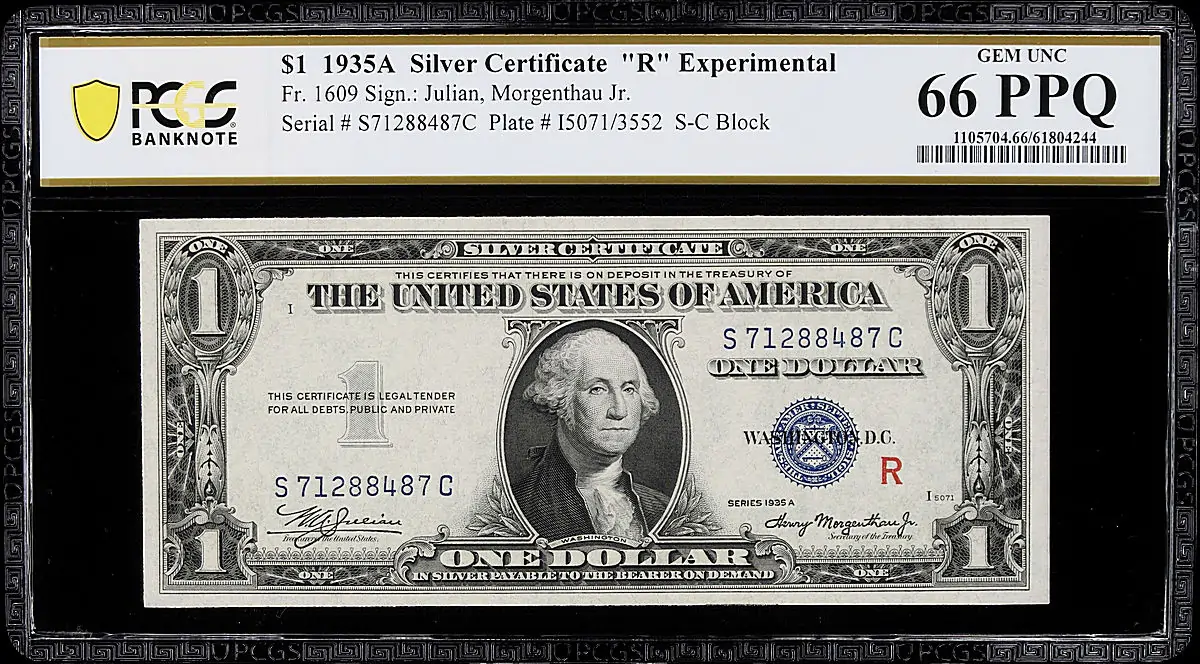
In June 1944, the Bureau of Engraving and Printing placed more than two million specially marked Silver Certificates into circulation. The bureau wanted to compare standard currency paper against a new experimental paper. Officials hoped the test would reveal which stock could better withstand the punishment of everyday use.
However, the experiment produced no clear winner.
More than 80 years later, the surviving notes rank among the most recognizable experimental issues in American paper money. On July 15, Stack’s Bowers Galleries will offer an exceptional example graded PCGS Banknote Gem Uncirculated 66 PPQ.
A One-Dollar Bill With a Wartime Assignment
The United States entered 1944 with the outcome of World War II still uncertain.
American factories supplied troops across Europe, North Africa, Asia, and the Pacific. Meanwhile, government agencies had to protect critical materials, maintain production, and prepare alternatives for nearly every essential supply.
Currency paper formed part of that planning.
The Bureau of Engraving and Printing needed paper that could survive constant folding, handling, moisture, dirt, and abrasion. Officials also worried about maintaining a reliable supply of security paper during the war.
Therefore, the bureau launched a controlled circulation test using Series 1935A $1 Silver Certificates. It chose the one-dollar denomination because those notes changed hands frequently and accumulated wear quickly.
The experiment followed earlier paper tests involving Series 1928 and Series 1935 Silver Certificates. However, the 1944 program added an unmistakable visual marker.
A large red letter told the two groups apart.
The Red “R” Did Not Mean Rare
Today, collectors naturally associate the red “R” with rarity. In 1944, however, the letter had a far more practical meaning.
R stood for Regular Paper.
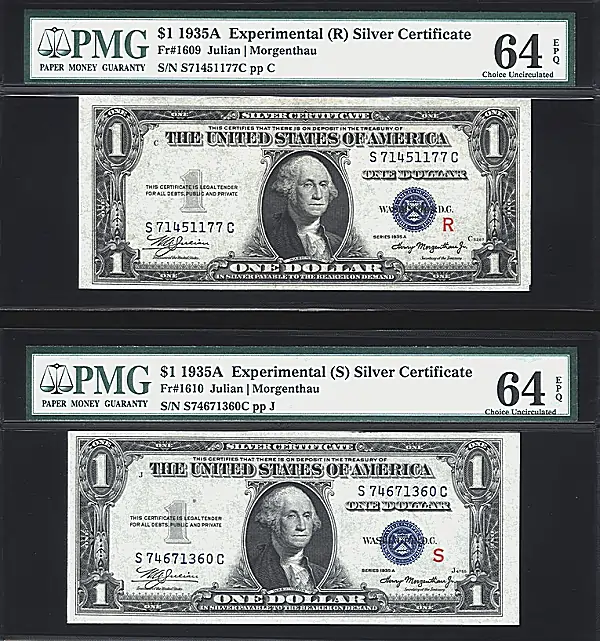
The BEP printed 1,184,000 notes on its regular currency paper. It then applied a large red “R” near the lower-right corner of the face.
Next, the bureau printed another 1,184,000 notes on the special experimental paper. Those notes received a large red “S.”
Therefore, the complete test included 2,368,000 Silver Certificates. The two groups entered circulation on June 20, 1944. The BEP reportedly conducted the circulation phase through Chicago, where ordinary commerce would subject the notes to real-world use.
That structure made the red “R” notes the experiment’s control group. Officials could compare their wear against the specially manufactured “S” notes.
The red overprints also gave Treasury personnel a quick way to identify each group after the notes returned through the banking system.
A Tiny Fraction of the 1935A Silver Certificate Issue
The BEP printed vast numbers of Series 1935A Silver Certificates. Against that enormous production, the 2,368,000 experimental notes represented less than 1% of the total issue.
Moreover, the bureau divided that already small quantity evenly between the two paper types.
The regular non-star “R” notes occupy the following serial-number range:
S 70884001 C through S 72068000 C
The regular non-star “S” notes occupy a later range:
S 73884001 C through S 75068000 C
Those serial numbers matter. A red letter alone does not establish authenticity. Collectors should confirm that a non-star experimental note falls within the correct range. Replacement notes form a separate and much scarcer category.
The R and S issues also hold a special place within the Silver Certificate series. They represent the only experimental Silver Certificates that the BEP identified with these prominent red-letter overprints.
Why the Experiment Failed
The BEP hoped normal circulation would supply a meaningful comparison between the two paper stocks.
Instead, officials reached no conclusive result.
Collectors often repeat a colorful explanation for that failure. According to hobby lore, members of the public noticed the unusual red letters and removed the notes from circulation as souvenirs. As a result, the notes never accumulated enough consistent wear to support a useful comparison.
That scenario appears plausible. After all, a bright red letter on a blue-seal Silver Certificate would have looked unusual even to someone with little interest in paper money.
The number of high-grade survivors also suggests that some people saved the notes early.
However, the historical record requires caution. Reliable sources confirm that the test produced no conclusive findings. They do not establish that public hoarding alone caused the failure. Difficulty tracking the notes through circulation may also have undermined the study.
Therefore, collectors should treat the hoarding explanation as a reasonable possibility rather than a proven fact.
That distinction matters. Numismatic stories often gain certainty each time someone retells them. CoinWeek separates documented history from appealing speculation.
From Failed Experiment to Collector Success
Although the BEP gained little from the trial, collectors eventually gained one of the most distinctive small-size currency varieties.
The notes combine several popular collecting themes:
They come from World War II. They feature a highly visible overprint. They carry tightly defined serial-number ranges. Finally, they connect directly to the federal government’s search for stronger and more reliable currency paper.
The red “R” also creates an appealing contradiction.
It marks the ordinary paper, not the experimental paper. Yet the control note now looks anything but ordinary.
Collectors often seek the R and S notes as a matched pair. The two pieces tell the complete story more effectively together. One represents the established currency stock. The other represents the proposed alternative.
In circulated grades, examples remain obtainable. However, strong Gem notes command far more attention. Paper money rarely survives eight decades without folds, stains, edge problems, or evidence of cleaning and pressing.
A Gem Red “R” Heads to Auction
Stack’s Bowers Galleries will offer Lot 91168 in its July 15, 2026, Collectors Choice Auction of U.S. Currency.
The note carries the Friedberg attribution Fr. 1609 and belongs to the SC serial-number block. PCGS Banknote graded it Gem Uncirculated 66 PPQ.
PCGS requires a note at the 66 level to display full margins and pleasing centering. The PPQ designation also recognizes premium paper quality and the degree of originality expected at that grade.
Stack’s Bowers describes the note as highly original, with strong eye appeal. The auction house estimates the note at $700 to $900 and lists a $650 starting bid. The U.S. Currency session begins at 3 p.m. Pacific Time, or 6 p.m. Eastern Time, on July 15.
That grade adds an important layer to the story.
The BEP created the note so people could spend it, fold it, carry it, and wear it down. Instead, someone apparently protected it before circulation could complete that assignment.
The note failed as a test subject. Yet it succeeded magnificently as a collectible.
A Dollar That Preserved Its Own Secret
The 1935A R Experimental Silver Certificate does not rely on an elaborate portrait or an exotic denomination.
Its appeal comes from one red letter.
That letter connects an ordinary dollar to wartime planning, government experimentation, paper technology, and the unpredictable behavior of the American public.
Most experiments disappear once researchers record the results. This experiment left the opposite legacy. The results disappeared, while the test pieces survived.
Today, the red “R” serves as a reminder that some of the most compelling objects in numismatics began as practical tools rather than collectibles.
The BEP wanted to learn how quickly a dollar would wear out.
Collectors made sure that at least a few never did.
The post The Red “R” Dollar: How a Failed Wartime Paper Test Created a Collector Classic appeared first on CoinWeek: Rare Coin, Currency, and Bullion News for Collectors.
from CoinWeek: Rare Coin, Currency, and Bullion News for Collectors https://ift.tt/Q8kUB5X


