In June 2001, the United States Mint released a commemorative silver dollar that stunned the hobby. Collectors responded immediately. Orders surged. Then, in just 15 days, the entire authorized mintage disappeared.

The 2001-D American Buffalo Silver Commemorative Dollar did more than honor a museum opening. It revived one of the most powerful designs in American numismatic history. At the same time, it connected modern collectors to a story rooted in the American frontier, Native heritage, and national memory.
That combination created lightning in a bottle.
A Museum, a Movement, and a National Moment
Congress authorized the coin under Public Law 106-375. The law created the American Buffalo Commemorative Coin Program. Its purpose was clear. The coin would celebrate the establishment of the Smithsonian Institution’s National Museum of the American Indian on the National Mall in Washington, D.C.
However, this was not merely a ceremonial gesture.
For generations, Native American history remained underrepresented in national institutions. The museum marked a turning point. It provided a permanent space dedicated to Indigenous cultures of the Americas. It also brought Native voices into the center of the nation’s capital.
Importantly, the commemorative coin helped fund that vision. Each silver dollar carried a $10 surcharge. Those funds supported the museum’s construction, endowment, and educational outreach.
Therefore, every coin sold carried both artistic weight and civic purpose.
Why the Buffalo Design Was Chosen
The Mint did not commission a new design. Instead, it returned to a masterpiece.
James Earle Fraser’s Buffalo Nickel debuted in 1913. From the start, the design captured the American imagination. Fraser grew up on the frontier. He witnessed the closing of the West. He also saw Native communities displaced and the great bison herds nearly vanish.
Those memories shaped his art.
Fraser created a composite Native American portrait for the obverse. He drew inspiration from three real individuals: Iron Tail (Sioux), Big Tree (Kiowa), and Two Moons (Cheyenne). He did not intend to depict a single person. Rather, he sought to represent enduring Native strength and dignity.
On the reverse, he placed an American buffalo standing firmly on a mound. The animal reflected both raw power and quiet resilience. The image became one of the most recognizable in U.S. coinage.
By 2001, collectors still revered the Buffalo Nickel. As a result, reviving the design in silver created instant emotional appeal.
A Classic Reborn in 90% Silver
The 2001 commemorative preserved Fraser’s original artistry. Yet the Mint elevated the presentation.
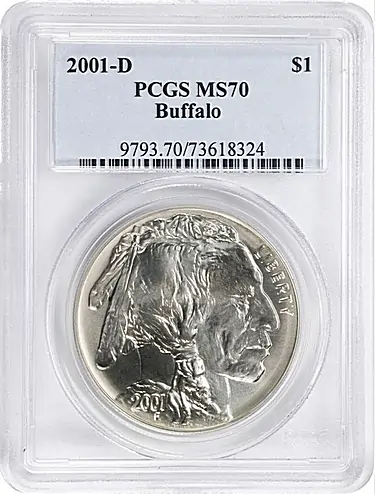 Unlike the original five-cent piece, the commemorative dollar features:
- A $1 denomination
- 90% silver composition
- A large 38.1 mm diameter
The expanded canvas allowed sharper detail and stronger relief. Collectors immediately noticed the difference.
The uncirculated version carries an incuse “D” mint mark for Denver. The proof version, struck in Philadelphia, bears a “P” mint mark.
Both versions share the same maximum authorized mintage. Congress capped the entire program at 500,000 coins combined. That cap proved decisive.
The 15-Day Sellout
Sales opened on June 7, 2001.
Collectors moved fast. Dealers placed heavy orders. Enthusiasm built across the hobby. By June 21, the United States Mint had sold the entire authorized mintage.
Fifteen days.
The final breakdown tells the story:
- 2001-D Uncirculated (Denver): 227,131
- 2001-P Proof (Philadelphia): 272,869
Demand reportedly ran so high that calls surfaced for additional production. However, Congress held firm. The 500,000-coin ceiling remained intact.
Consequently, the commemorative locked in its scarcity from the beginning.
Cultural Weight and Numismatic Impact
This commemorative silver dollar stands at the intersection of art and history.
- First, it honors the opening of a major Smithsonian museum dedicated to Indigenous peoples of the Americas. That alone gives it lasting cultural relevance.
- Second, it resurrected a design that collectors rank among the finest in U.S. coinage.
- Third, its runaway success demonstrated the enduring popularity of Fraser’s Buffalo motif. Just five years later, in 2006, the U.S. Mint introduced the 24-karat Gold Buffalo bullion program. The groundwork for that success traces directly to the enthusiasm generated in 2001.
In other words, this commemorative proved that classic American design still sells—especially when paired with purpose.
A Modern Commemorative With Staying Power
Many modern commemoratives struggle to hold collector attention. This one did not.
Its mintage remains modest by modern standards. Its design carries instant recognition. Moreover, its backstory connects to a meaningful national milestone.
The 2001-D American Buffalo Silver Commemorative Dollar captures a rare convergence. It unites congressional intent, cultural recognition, and numismatic artistry.
Most importantly, it sold out in two weeks and never looked back.
That fact alone ensures its place in the modern commemorative canon.
The post The 2001-D American Buffalo Silver Commemorative Dollar: The 15-Day Sellout That Revived a Legend appeared first on CoinWeek: Rare Coin, Currency, and Bullion News for Collectors.
from CoinWeek: Rare Coin, Currency, and Bullion News for Collectors https://ift.tt/tes9Ffl


