By Jeff Garret
Want to collect this series?
Start with the remarkable group of inaugural 2000 issues and decide how far your budget can take you.
The U.S. Mint recently made an unusual move when it auctioned five examples of the 2000-W Sacagawea Dollar struck in gold. Collectors had never before had access to these numismatic “delicacies.” The five coins sold for prices ranging from $350,000 to $500,000 each.
The story behind those coins, and the short-lived Sacagawea Dollar series itself, offers one of the most fascinating chapters in modern U.S. numismatics.

The Mint also celebrated the coin’s 25th anniversary in 2025 with another gold Sacagawea Dollar. Collectors responded enthusiastically and quickly purchased all 7,500 coins.
Collectors can assemble a basic set of Sacagawea Dollars from 2000 through 2008 without much difficulty. However, anyone seeking every significant variety, special strike, and rarity will need a considerable fortune.
The Sacagawea Dollar Arrives
The U.S. Mint introduced the Sacagawea Dollar in 2000. A golden color and plain edge helped distinguish it from other coins of similar size.
The earlier Susan B. Anthony Dollar had struggled because its size and color too closely resembled the circulating Quarter Dollar. Congress addressed that problem through the United States Dollar Coin Act of 1997, which mandated a new alloy and a different appearance for the next Dollar coin.
The Mint struck the Sacagawea Dollar on a pure copper core with an outer layer of manganese brass, which gave the coin its distinctive golden color.
Famed sculptor Glenna Goodacre created the obverse design. It depicts Sacagawea, the Shoshone woman who assisted the Lewis and Clark expedition. Thomas D. Rogers created the reverse.
The Mint’s 2000 launch produced one of the most complex and rarity-filled first years in U.S. coinage history.
Here are the major issues from that remarkable debut year.
2000-P Goodacre Presentation Finish
Mintage: 5,000
Graded by NGC: 302
Finest Graded by NGC: MS 68
Glenna Goodacre enjoyed a good working relationship with then-Mint Director Philip Diehl. She also showed remarkable foresight when she asked the Mint to pay her $5,000 design fee in newly struck Sacagawea Dollars.
On April 5, 2000, Diehl and two Mint Police officers personally delivered the coins to Goodacre’s studio during a special ceremony.
During early Sacagawea Dollar production, the Mint encountered discoloration problems. As a result, Mint personnel gave many of Goodacre’s coins a burnished appearance that created a distinctive finish.
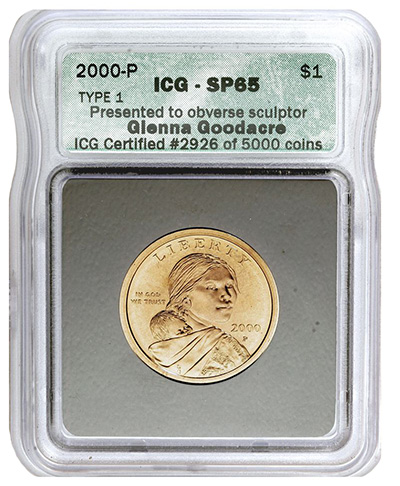
Those coins eventually produced a financial windfall for Goodacre.
Her studio began selling the presentation pieces for about $200 each. Buyers purchased nearly 3,000 coins before U.S. Mint officials protested the sales. Goodacre then stopped selling them.
In 2010, Coin World published a 10th-anniversary article about the Sacagawea Dollar. The article discussed the presentation coins, the controversy surrounding the sales, and approximately 2,000 pieces that remained unsold.
Thanks to Google, I found Goodacre’s agent and contacted him about the remaining coins.
A few months later, her agent, Dan Anthony, called me. He apologized for the delay and explained that they had misplaced the coins. Eventually, they found the group in a wine cellar.
They also wanted to sell them.
A quick trip to Santa Fe resulted in my purchase of all 2,000 coins.
I quickly placed most of the coins into the marketplace, although I retained several pieces for my collection. I also developed a strong relationship with Goodacre and her agent.
Later, I helped facilitate the transfer of Goodacre’s archival material and early Sacagawea Dollar designs to the Smithsonian’s National Numismatic Collection, where they remain today.
That material provides a fascinating look at numismatic “what could have been.”
2000-P Cheerios Prototype Sacagawea Dollar
Mintage: 5,500
Graded by NGC: 62
Finest Graded by NGC: MS 69

This famous Sacagawea Dollar variety features an early reverse design with prominent diagonal lines on the eagle’s tail feathers.
The Mint used this early die style before modifying the eagle’s tail feathers for regular production. The later design shows the feathers with parallel lines.
The Mint also used the prototype reverse for the small group of 2000-W gold Sacagawea Dollars discussed below.
To promote the new Dollar coin, the U.S. Mint worked with General Mills on a nationwide treasure hunt. General Mills placed 5,500 Sacagawea Dollars into Cheerios cereal boxes, at a rate of roughly one coin for every 2,000 boxes.
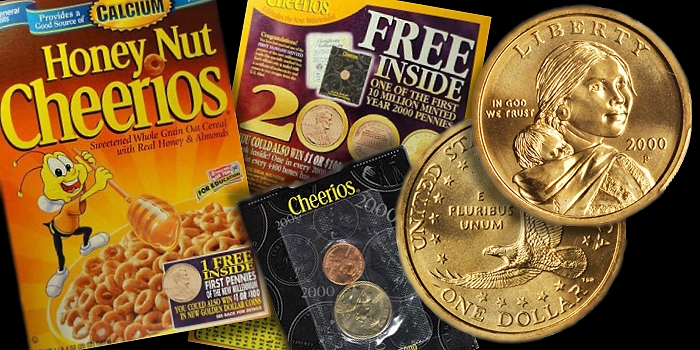
Collectors did not recognize the distinctive reverse variety until 2005, when a collector sent an example to NGC for authentication and grading.
By then, consumers had already spent or scattered most of the coins.
Examples still surface occasionally. When they reach auction, they can command prices in the thousands of dollars.
The variety also creates headaches for coin shops across the country because members of the public often struggle to identify the subtle reverse differences.
2000-W Gold Sacagawea Dollar
Mintage: 39
Net Mintage: 12
The U.S. Mint produced 39 Sacagawea Dollars in 22-karat gold in 1999, reportedly at the West Point Mint, although Philadelphia has also entered the discussion surrounding their production.

The Mint later melted all but 12.
Mint workers struck the coins with the prototype reverse design, which features boldly detailed tail feathers. As noted above, the Mint also used that prototype reverse on the early circulation strikes that later appeared in Cheerios cereal boxes.
The Mint sent the surviving dozen gold coins aboard the Space Shuttle Columbia to honor astronaut Eileen Collins, the first woman to command a Space Shuttle mission.
The coins traveled approximately 1.8 million miles.
After the flight, the government stored them at Fort Knox. The Mint last displayed the coins publicly at the 2007 World’s Fair of Money in Milwaukee.
More recently, the U.S. Mint sold five examples. Those sales immediately created some of the rarest and most expensive modern U.S. coins in collector hands.
2000-P Sacagawea Dollar
Mintage: 767,140,000
Graded by NGC: 7,089
Finest Graded by NGC: MS 69
The enormous mintage makes the 2000-P Sacagawea Dollar extremely common. Collectors can locate examples with little effort.
However, this issue also has an interesting international connection.
Several hundred million Philadelphia and Denver Sacagawea Dollars went to Ecuador, where people used them extensively in everyday commerce.
2000-D Sacagawea Dollar
Mintage: 518,916,000
Graded by NGC: 1,751
Finest Graded by NGC: MS 69
The Denver issue also remains common.
However, collectors face a much greater challenge when searching for examples at the very highest levels of preservation.
2000-D Sacagawea Burnished Millennium Dollar
Mintage: 75,000
Graded by NGC: 439
Finest Graded by NGC: MS 69
The U.S. Mint offered the United States Millennium Coin and Currency Set in its 2000 Holiday Catalog.
Each set contained a 2000 American Silver Eagle, a 2000-D Sacagawea Dollar, and a $1 Federal Reserve Note with a serial number beginning with “2000.”
The Mint sold the sets for $39 each.
The Sacagawea Dollar in the Millennium set displays a distinctive finish similar to the appearance of the Goodacre Presentation coins discussed above.
2000-S Sacagawea Dollar Proof
Mintage: 4,047,904
Graded by NGC: 17,963
Finest Graded by NGC: PF 70 Ultra Cameo
The reported mintage reflects the total number of coins included in the year’s Clad and Silver Proof Sets.
Additional 2000 Sacagawea Dollars
The Mint produced still more unusual Sacagawea Dollars during VIP ceremonies at the Philadelphia and Denver Mints.
In some cases, invited dignitaries and guests pushed the buttons that struck individual coins.

Collectors rarely encounter these pieces today, which makes them especially desirable.
Yet the Mint still had one more extraordinary chapter to add to the story.
During the 2000s, someone at the Mint produced a small number of mule errors that combined the obverse of a Washington Quarter with the reverse of a Sacagawea Dollar.
Research suggests that Mint employees probably produced the coins intentionally.
2000 Sacagawea Dollar / Washington Quarter Mule
Authorities arrested two different Mint employees in connection with the case.
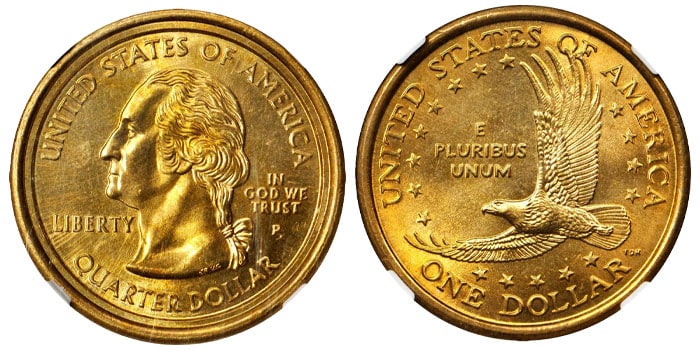
The U.S. Mint never sought the return of the coins. As a result, collectors can buy and sell the mules freely, although at very high prices.
One collector became especially fascinated with the issue and, at last count, owned the majority of the known examples.
A First Year Unlike Any Other
Many numismatists enjoy collecting first-year issues. Few modern U.S. coins offer a challenge as deep or as varied as the 2000 Sacagawea Dollar.
Collectors can pursue ordinary Philadelphia and Denver circulation strikes. They can hunt the Goodacre Presentation coins, Millennium Set pieces, Cheerios prototypes, special VIP strikes, the gold space-flown Dollars, or the famous Washington Quarter mule.
Together, these coins document the Mint’s latest major attempt to create a practical alternative to the paper Dollar.
Despite decades of experimentation, Americans never embraced Dollar coins for everyday commerce on a large scale.
Coin collectors, however, became the beneficiaries of that experiment.
The Sacagawea Dollar may have struggled to replace paper currency, but its extraordinary first year created one of the richest collecting fields in modern American numismatics.
The post The Incredible 2000 Sacagawea Dollars appeared first on CoinWeek: Rare Coin, Currency, and Bullion News for Collectors.
from CoinWeek: Rare Coin, Currency, and Bullion News for Collectors https://ift.tt/bE12dfZ


