Few United States coin denominations have failed as quickly, or as quietly, as the Twenty-Cent Piece. Authorized in the mid-1870s and struck for only four years, this oddball silver coin never found its footing with the American public. Today, it survives as a fascinating numismatic footnote, prized more for its rarity and story than for its brief role in commerce.
The United States Mint produced the Twenty-Cent Piece from 1875 through 1878. However, circulation issues were limited to just two years: 1875 and 1876. By the final two years of production, the denomination had already been abandoned for commerce, with the Mint striking only Proofs for collectors. In total, just 1,100 Proof Twenty-Cent Pieces were sold across 1877 and 1878.
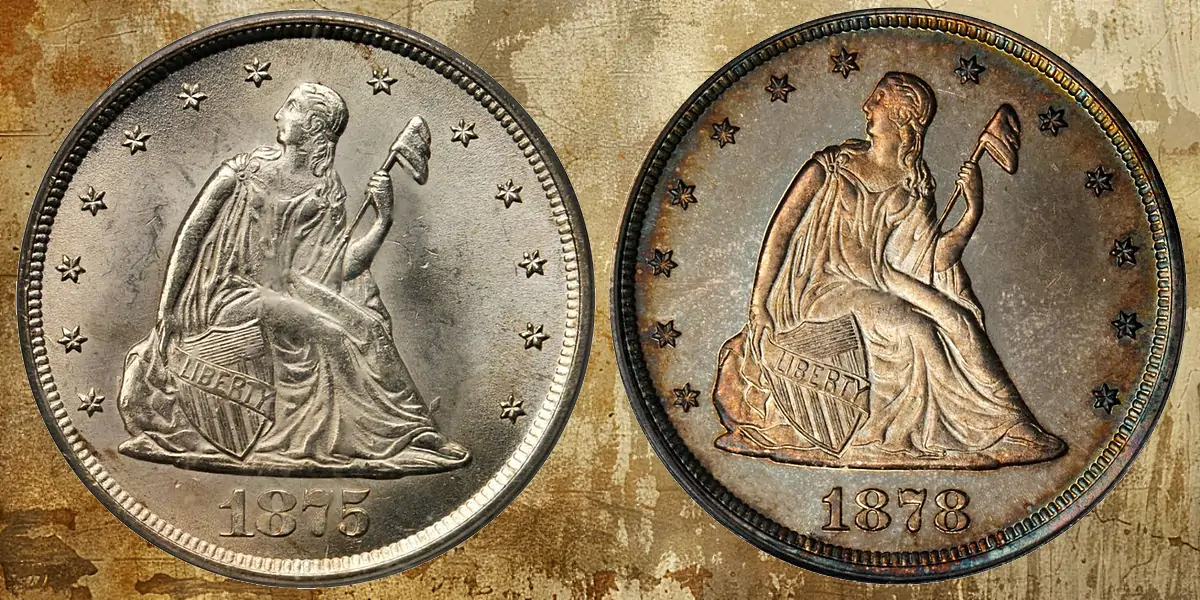
That short production window, combined with low survival rates, places the Twenty-Cent Piece among the most intriguing, and misunderstood, series in American numismatics.
Why Create a Twenty-Cent Coin?
At first glance, the Twenty-Cent Piece seems unnecessary. After all, the quarter dollar had circulated successfully for decades. Yet the coin’s origins lie at the intersection of politics, silver interests, and post–Civil War monetary policy.
Although proposals for a twenty-cent denomination date back to the late 18th century, the idea gained traction only after the Coinage Act of 1873 ended the free coinage of silver. That legislation, later dubbed the “Crime of ’73” by its critics, sent shockwaves through western mining interests.
In response, newly elected Nevada Senator John Percival Jones pushed Congress to authorize a new silver coin. Jones argued that a Twenty-Cent Piece would serve two purposes. First, it would provide an additional outlet for domestic silver production. Second, it could compete with European silver coins struck to the standards of the Latin Monetary Union in foreign trade.
Congress saw another potential benefit. With the half dime discontinued in 1873 and small-denomination coins struck only at the Philadelphia Mint, the western states faced persistent shortages of small change. A new silver coin, lawmakers hoped, could ease commerce west of the Mississippi.
On paper, the idea made sense. In practice, it did not.
A Design Too Close for Comfort
The failure of the Twenty-Cent Piece can be traced directly to its design.
Chief Engraver William Barber, working under Mint Director Henry Linderman, adapted the familiar Liberty Seated motif for the new denomination. The obverse closely resembled the quarter dollar, while the reverse featured an eagle of similar size and posture.
Yes, the Twenty-Cent Piece had a plain edge instead of the quarter’s reeded edge. However, that distinction proved far too subtle in daily commerce. Worn quarters often lost their reeding, making the two coins nearly indistinguishable in circulation. As a result, merchants and consumers frequently confused the denominations, often to their financial detriment.
Despite experimentation with pattern designs, the Mint never produced a coin that clearly separated the Twenty-Cent Piece from the quarter dollar. Public confidence eroded quickly, and acceptance never followed.
Mintages and Circulation Realities
The Twenty-Cent Piece was struck at three facilities: the Philadelphia Mint, the Carson City Mint, and the San Francisco Mint.
In 1875, the San Francisco Mint anticipated strong export demand and produced a substantial 1,155,000 pieces. Carson City struck 133,290 coins that year, while Philadelphia contributed just 38,500.
Fortunately for collectors, a meaningful number of 1875-S examples survive today in grades ranging from XF through Mint State. As a result, the issue remains one of the most accessible entry points for collectors seeking a Twenty-Cent type coin.
The following year told a different story.
The 1876-CC Twenty-Cent Piece was struck to a modest mintage of 10,000 coins. Nearly the entire production run was melted before release. Today, fewer than 20 examples are believed to survive, making it one of the great rarities of 19th-century American silver.
By 1877, the writing was on the wall. The denomination was dead.
Proof-Only Farewell
Although circulation strikes ended after 1876, the Mint continued to produce Proof Twenty-Cent Pieces in 1877 and 1878. These coins were struck exclusively for collectors, with mintages of just 350 and 600 pieces, respectively.
Many have since been lost, mishandled, or impaired. High-grade Proof survivors with strong eye appeal are legitimately scarce. and fiercely contested when they appear at auction.
Coin Profiles: Two Twenty-Cent Pieces We Love
1878 Twenty-Cent Piece, Proof-66 Cameo (PCGS), CAC
The 1878 Proof Twenty-Cent Piece represents the final chapter of this ill-fated denomination—and it does so with unmistakable elegance. Struck as a Proof-only issue with a mintage of just 600 pieces, the 1878 Twenty-Cent Piece is scarce in any condition. In high-grade Cameo format, it is genuinely rare.

This PCGS Proof-66 Cameo example, approved by CAC, displays the kind of visual drama collectors hope for but seldom encounter. The mirrored fields are deep and reflective, providing bold contrast against frosty, sharply defined devices. At the obverse periphery, rich gold and electric blue toning frame Liberty with remarkable intensity, while the centers remain brilliantly luminous.
The reverse is equally compelling. A classic “bullseye” toning pattern radiates outward from the eagle, transitioning through concentric rings of gold, orange, crimson, and deep neon blue. The effect is dynamic, balanced, and unmistakably original.
Technically, the strike is outstanding, with full definition throughout the stars, shield, and eagle’s feathers. Just as important, the eye appeal fully supports the assigned grade, placing this coin among the elite survivors of the series.
Provenance adds another layer of appeal. This piece resided in the Teich Family Collection for more than half a century, making its appearance at auction a true “fresh” opportunity—exactly the kind of coin that ignites strong bidding in today’s competitive numismatic marketplace.
As a capstone to the Twenty-Cent series, few coins speak more eloquently to both its promise and its premature end.
1875-CC Twenty-Cent Piece, MS-65 (PCGS), CAC
Among circulation strikes, the 1875-CC Twenty-Cent Piece stands as the undisputed cornerstone of the series. Struck at the Carson City Mint during the denomination’s inaugural year, the issue combines historical importance with genuine scarcity in high Mint State grades.
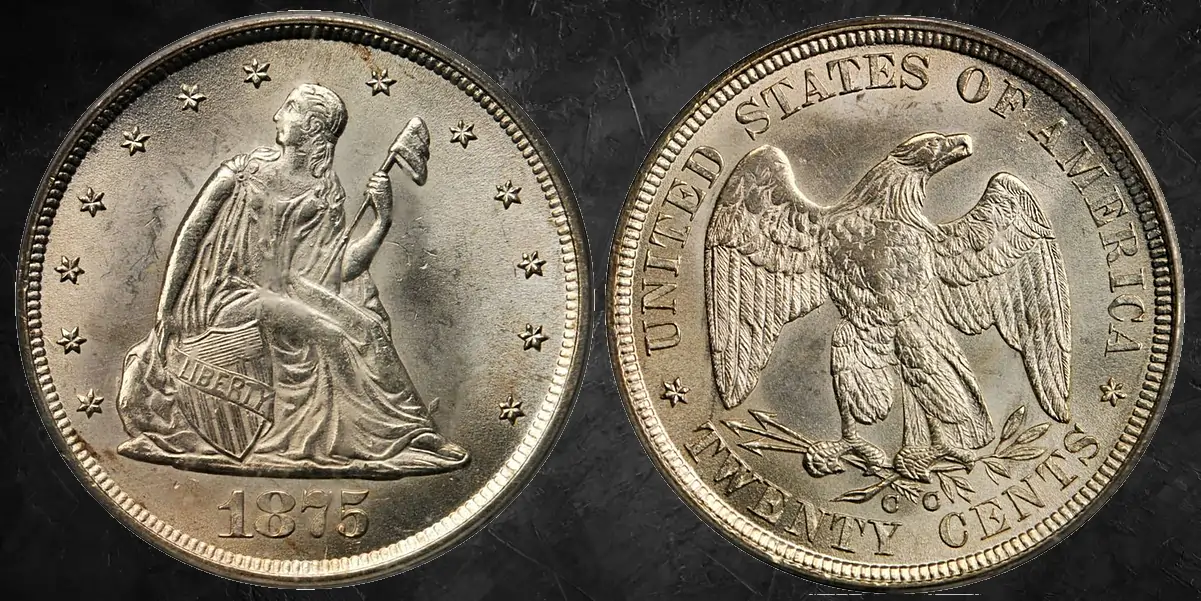
This PCGS MS-65 example, verified by CAC, represents the series at its finest. Both obverse and reverse are predominantly blast white, accented by the faintest whisper of golden patina. Strong, swirling mint luster animates the fields, while the devices display crisp frost and excellent contrast.
The strike is notably sharper than average for the issue. Although a trace of softness remains at the top of the eagle’s left wing—a known characteristic of the date—the overall impression is one of precision and care. Surface preservation is exceptional, with virtually no distracting marks visible under magnification.
Beyond its condition, the coin invites closer study of the denomination’s subtle design differences. The plain edge, raised lettering on the shield, and the bold “20 CENTS” inscription were all intended to distinguish the coin from the quarter dollar. Less discussed, however, is the reverse’s heraldic symbolism.
Here, the eagle grasps arrows in its right claw and an olive branch in its left—a configuration traditionally interpreted as prioritizing strength over peace. While this arrangement appeared on earlier U.S. coinage, its revival in the post–Civil War era feels curious and perhaps unintended, serving yet another attempt to differentiate the Twenty-Cent Piece from its quarter-dollar cousin.
In the end, this superb 1875-CC stands as both a technical triumph and a historical cautionary tale—proof that even well-intentioned coinage experiments can falter when execution misses the mark.
A Short Run, a Long Legacy
The Twenty-Cent Piece failed because it tried to solve too many problems at once—and solved none of them well. Yet its brief life has secured it a lasting place in American numismatics. For collectors, the series offers rarity, political intrigue, and undeniable charm.
Sometimes, the shortest-lived coins leave the longest impressions.
Read more CoinWeek articles on Twenty Cent Pieces
* * *
The post The Twenty-Cent Piece: America’s Shortest-Lived Silver Experiment appeared first on CoinWeek: Rare Coin, Currency, and Bullion News for Collectors.
from CoinWeek: Rare Coin, Currency, and Bullion News for Collectors https://ift.tt/XJs6pg7


